When Will the Temperatures Began to Rise Again This Winter
Major changes are coming in 2022 beyond the atmosphere and the oceans, creating unlike weather condition patterns into the second half of the year, and especially in the cold flavor after in the year. The changes will commencement slowly, but the master shift volition start to occur during the 2022 warm season.
But what exactly is changing this twelvemonth, and what weather patterns resulted from such changes in the past?
We volition go on a weather journey through 2022, starting with a seasonal conditions design forecast for belatedly winter and early parts of the Leap. From there we will go into the atmosphere and the oceans, to observe what is irresolute already, and what is even so to come up. You will encounter how and why these global changes occur, and what is going to exist different in 2022, compared to the final few years.
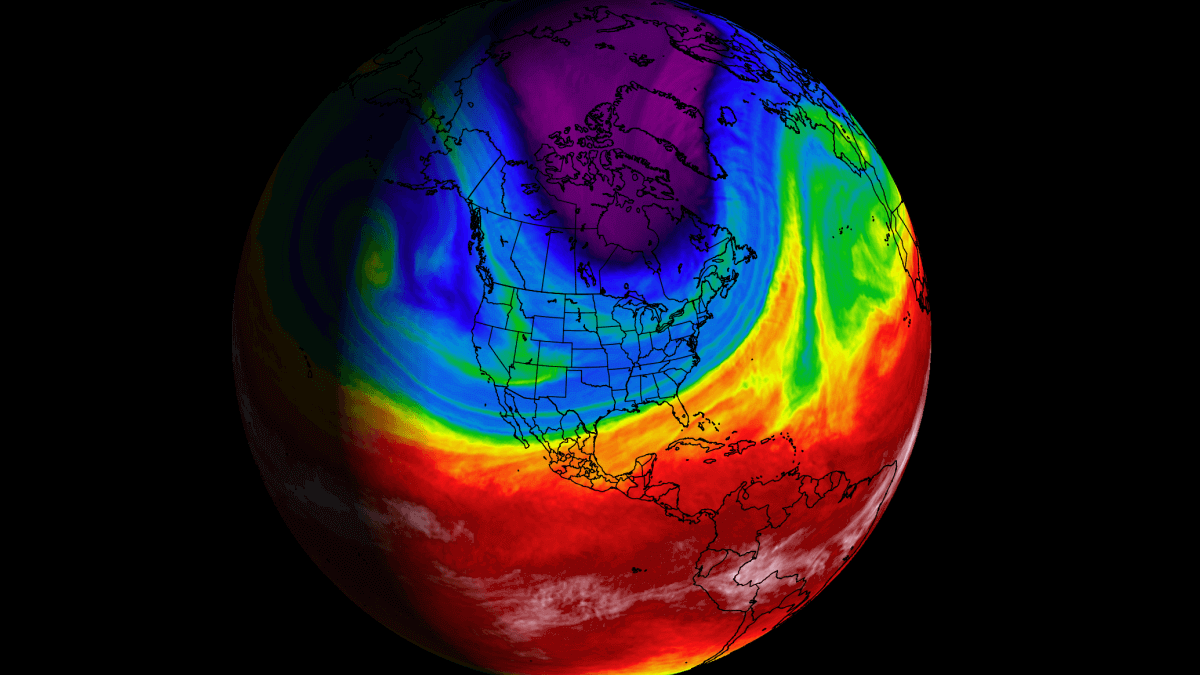
ENSO IN THE PACIFIC
We are starting off with the electric current weather condition conditions, brought on from the 2021 cold season. Winter is yet ongoing and driven largely past a cold ENSO phase.
ENSO is short for "El Niño Southern Oscillation". This is a large oceanic region in the tropical Pacific, that is regularly changing between warm and cold phases. It has a major touch on the tropical convection patterns (storms), pressure level patterns, and thus on the interaction betwixt the ocean and the atmosphere.
We can observe large-calibration pressure changes in the tropics every bit ENSO shifts between warm and common cold phases. With some delay, these changes directly affect the circulation over the rest of the globe.
The image below shows the ENSO regions in the tropical Pacific. Primary analysis (and forecast) is done for a combination of regions iii and 4, seen on the paradigm equally the Nino 3.4 region. Region 3 covers the eastern tropical Pacific, while region iv covers the central and almost of the western tropical Pacific.

Each ENSO stage has a dissimilar effect on the pressure and weather in the tropics. Over time, this translates to the overall global circulation, impacting the weather worldwide differently. A specific phase (cold/warm) ordinarily develops between tardily summer and fall and typically lasts into next Spring. Some stronger events can final even upwards to two years.
The cold ENSO phase is chosen La Nina and the warm stage is chosen El Nino. Their names literally translate to "the girl" (La Nina), and "the male child" (El Nino), indicating an contrary dynamic between the two phases.
Only besides the bounding main temperatures, i of the more than important differences is likewise in the pressure pattern. During an El Nino, the pressure over the tropical Pacific is lower, with more rainfall and storms and westerly winds.
Merely during a La Nina, the pressure over the equatorial Pacific is high, creating stable weather condition and less precipitation. This directly translates into the global circulation, affecting the jet stream on both Hemispheres over time.
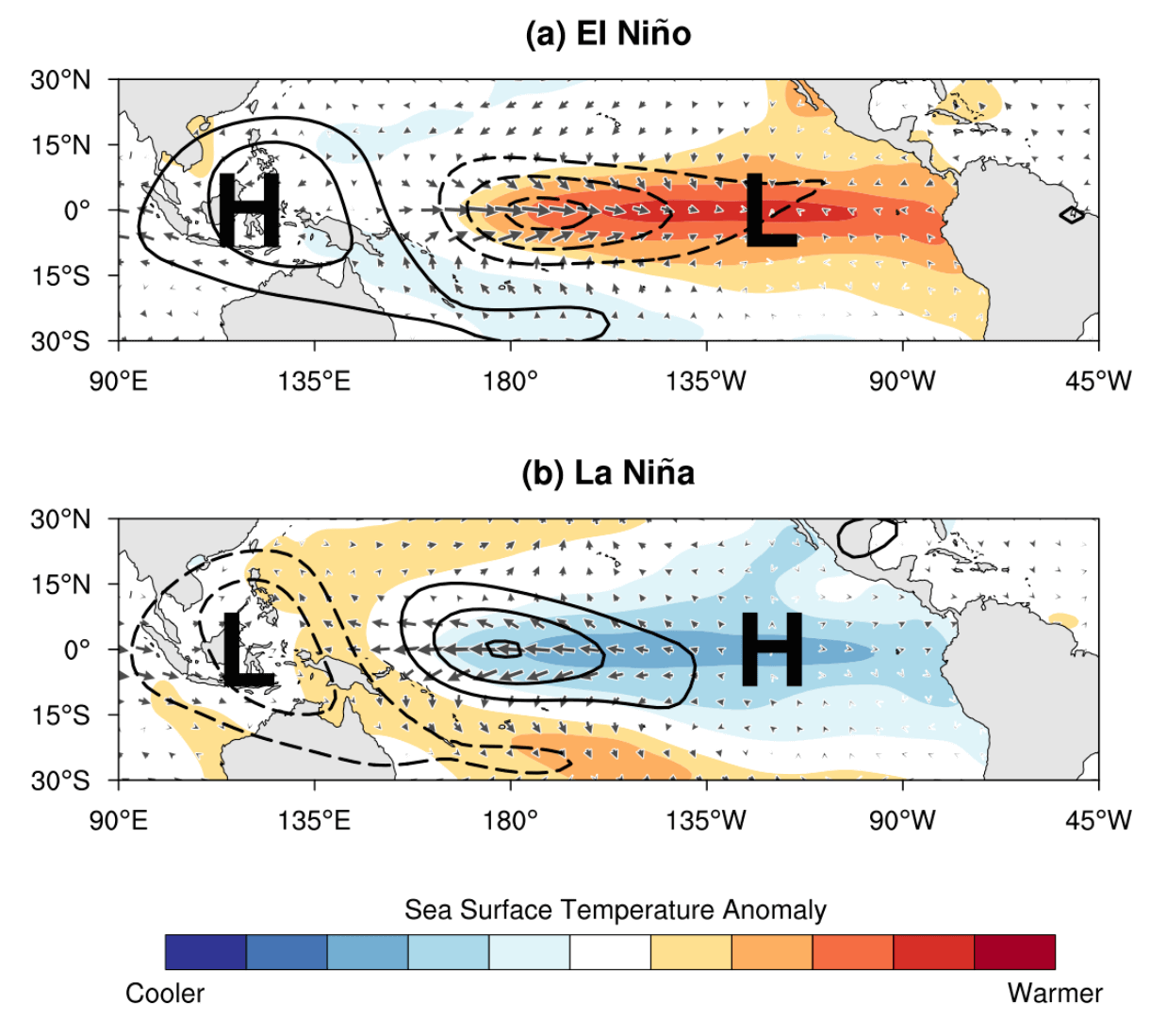
The image beneath from NOAA Climate shows the typical circulation during a cold ENSO phase that we are currently in. Air is descending in the eastern Pacific, causing stable and dry weather, while lower pressure and ascent air cause frequent thunderstorms and a lot of rainfall over the western Pacific.

This way, ENSO has a major touch on on the tropical rainfall and force per unit area patterns and impacts the bounding main-atmosphere feedback system. We usually observe a global shift in pressure patterns during the emergence of an ENSO phase just it is usually most influential during the meridian of the stage and its decay.
Below we have the latest global ocean temperature anomaly from NOAA. Nosotros tin can conspicuously meet the potent cold anomalies in the tropical Pacific Ocean. That is the currently active La Nina phase. The strongest cold anomalies are reaching beneath 3°C colder than the long-term average. Overall, the electric current effect is marked as a moderately-strong La Nina.

The loftier-resolution video animation below shows the ocean temperature anomalies from Summertime to late Fall. You can encounter new cooling starting in July, as the cold "waveforms" develop across the equatorial Pacific. They grade equally the surface h2o is beingness pushed westward by the trade winds, bringing deeper colder water to the surface.
Below we take an image that shows the average winter pressure pattern from multiple La Nina winters. The primary feature is a strong high-pressure system in the North Pacific and low pressure level over Canada. That is the typical signature of the common cold ENSO phase. Over the N Atlantic and Europe, the blueprint is not as strong as the ENSO influence is mitigated by local force per unit area patterns.
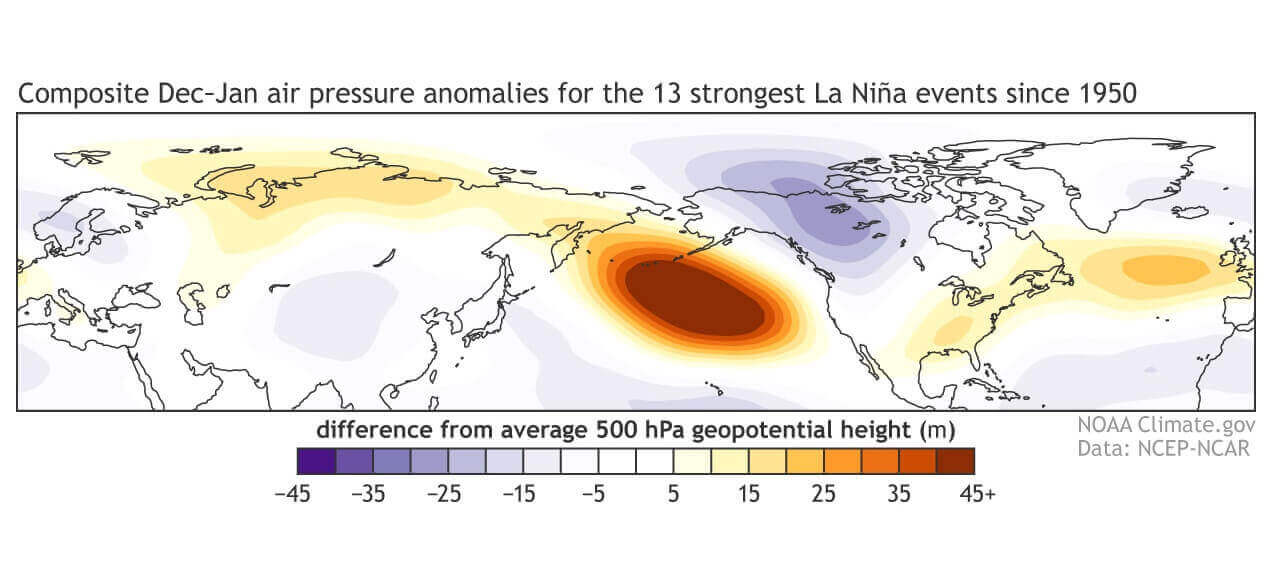
We now know what this La Nina is, and how it usually impacts the conditions. That is why we will look at its atmospheric condition influence in the first office of 2022, going from Winter Into Spring, when this cold ocean anomaly will finally start to disappear.
Early 2022 SEASONAL WEATHER FORECAST
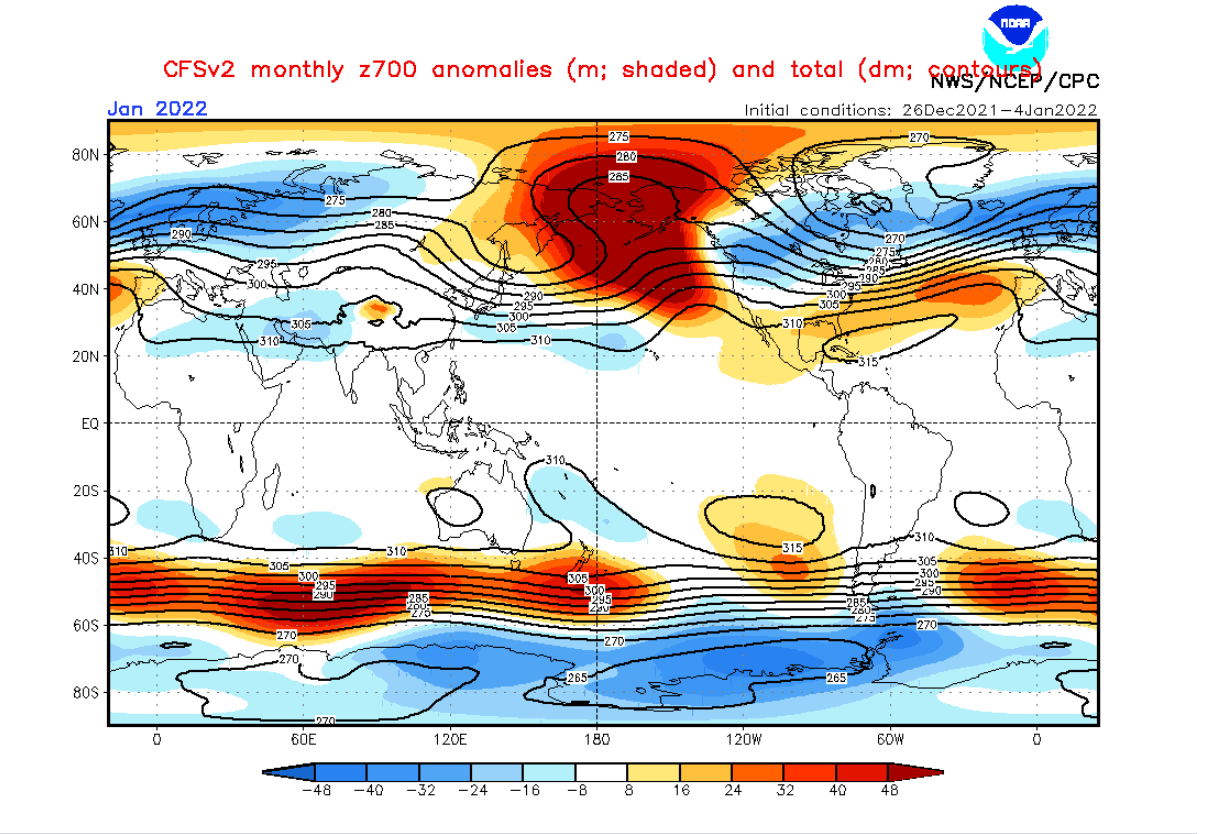
The January pressure blueprint forecast below shows a strong signature of the La Nina. A dominant high-pressure arrangement in the North Pacific, with a low-pressure level zone over Canada and the northern United States.
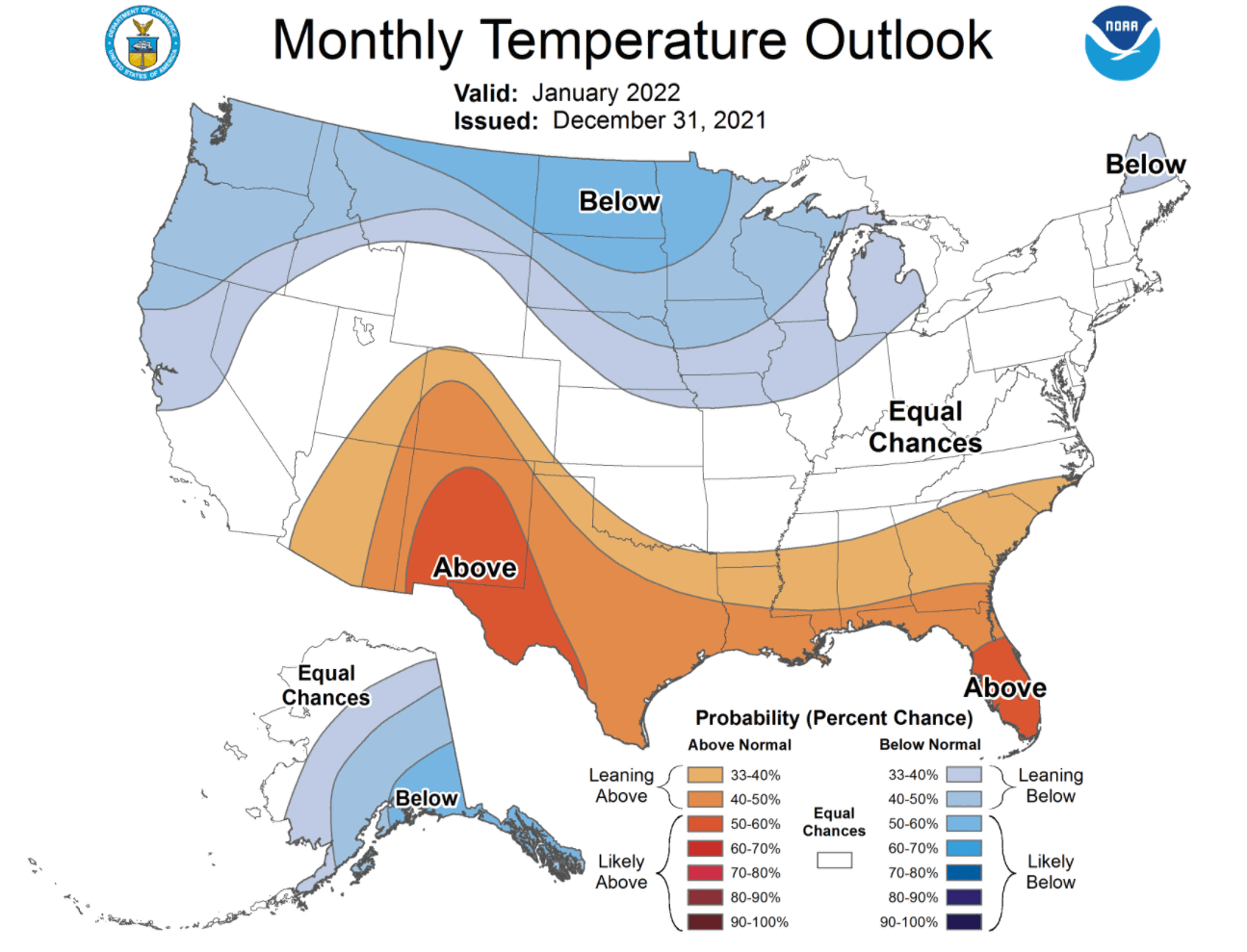
Looking at the official Jan temperature outlook from NOAA, we see the colder weather over much of the northern United states of america. Colder air is expected to also spread frequently from the northwestern United States and the Midwest into central and eastern parts of the state.
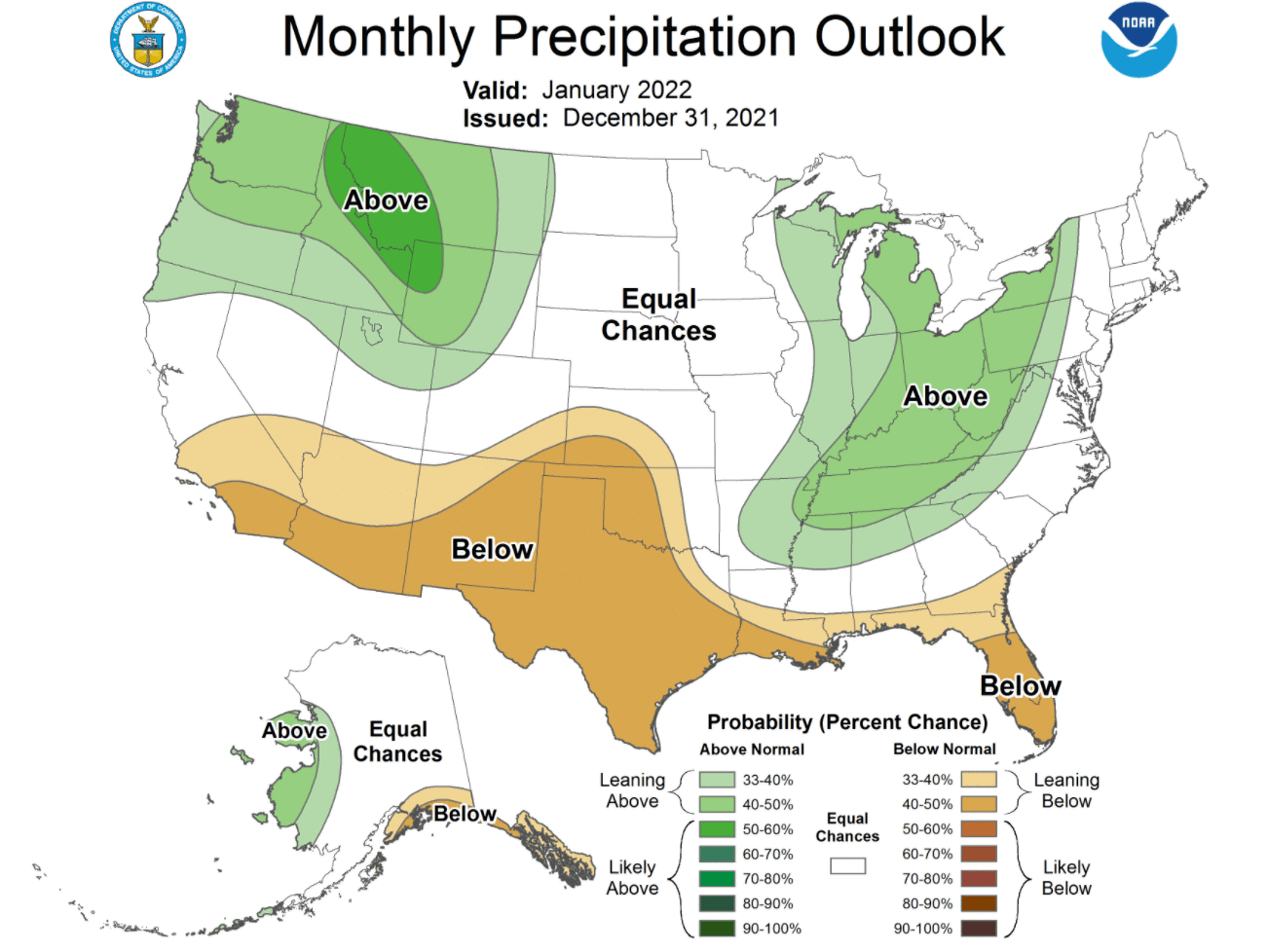
The precipitation blueprint follows the colder air, equally a supply of moisture is available. Colder air and moisture as well mean snowfall, especially for parts of the northern and eastern United States.
FROM WINTER TO SPRING
Going forward, we will be looking at the latest forecast information for the Winter-Jump transition menses. The forecast was issued before this month by EMCWF and covers the February-March-April (FMA) menstruation.
As we tin meet below on the pressure design forecast, the stiff loftier-pressure system in the North Pacific is nonetheless present. That is the fingerprint of the La Nina and is probable to stay present well into the early Spring flavour. Notice the much lower pressure over Canada and Greenland, curving the jet stream into the northwestern United States and into the North Atlantic.

Lower pressure over Greenland helps to keep the jet stream more to the north, allowing a high-pressure level area to expand over much of Europe.
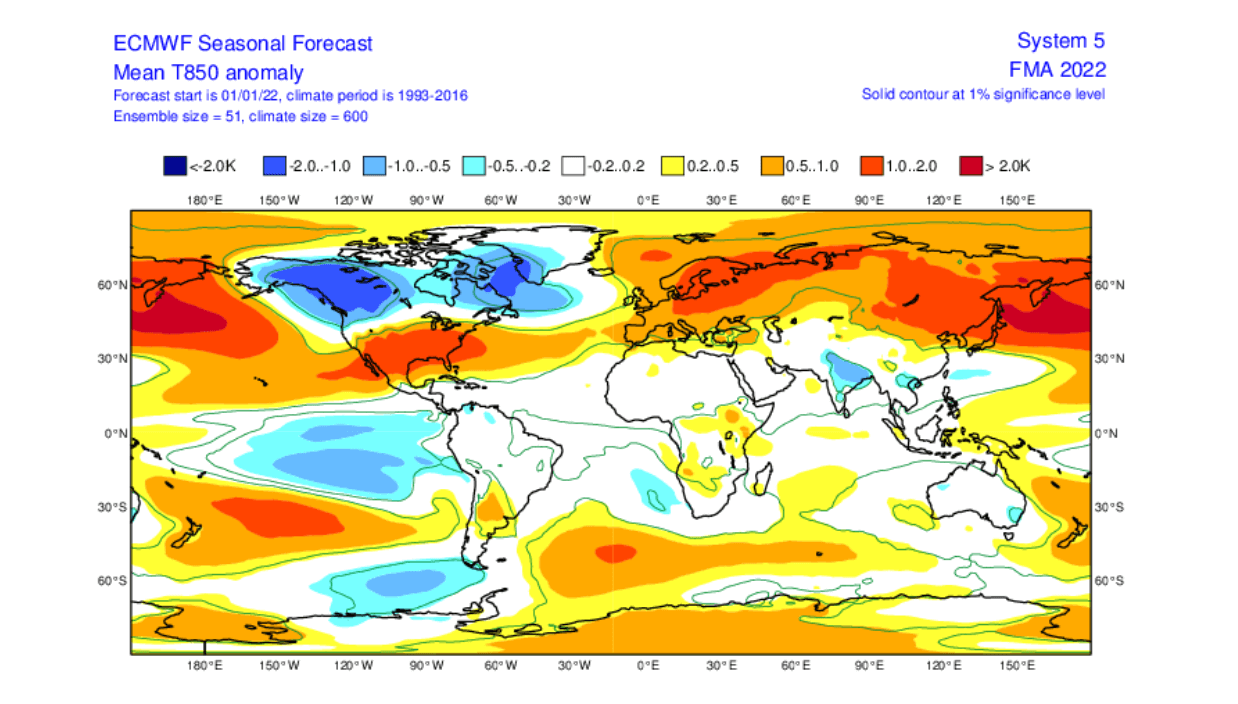
That is reflected in the global airmass temperatures, as we encounter a strong cold puddle in western Canada. That has formed last calendar month and is set to stay into the early Spring season. Yous tin notice the warmer temperatures over much of Europe, which would suggest a pattern change to a more westerly period in early 2022.
Taking a closer await at Europe, the surface temperatures are mostly higher up normal over the north and northeast. There is yet a weaker warm anomaly over western Europe, suggesting that colder air intrusions can proceed into western and parts of central Europe.
That is similar to what we have seen in Dec, simply with a reduced frequency. These forecasts only evidence the prevailing or boilerplate picture over the course of 3 months, which can contain a lot of sub-seasonal dynamics.

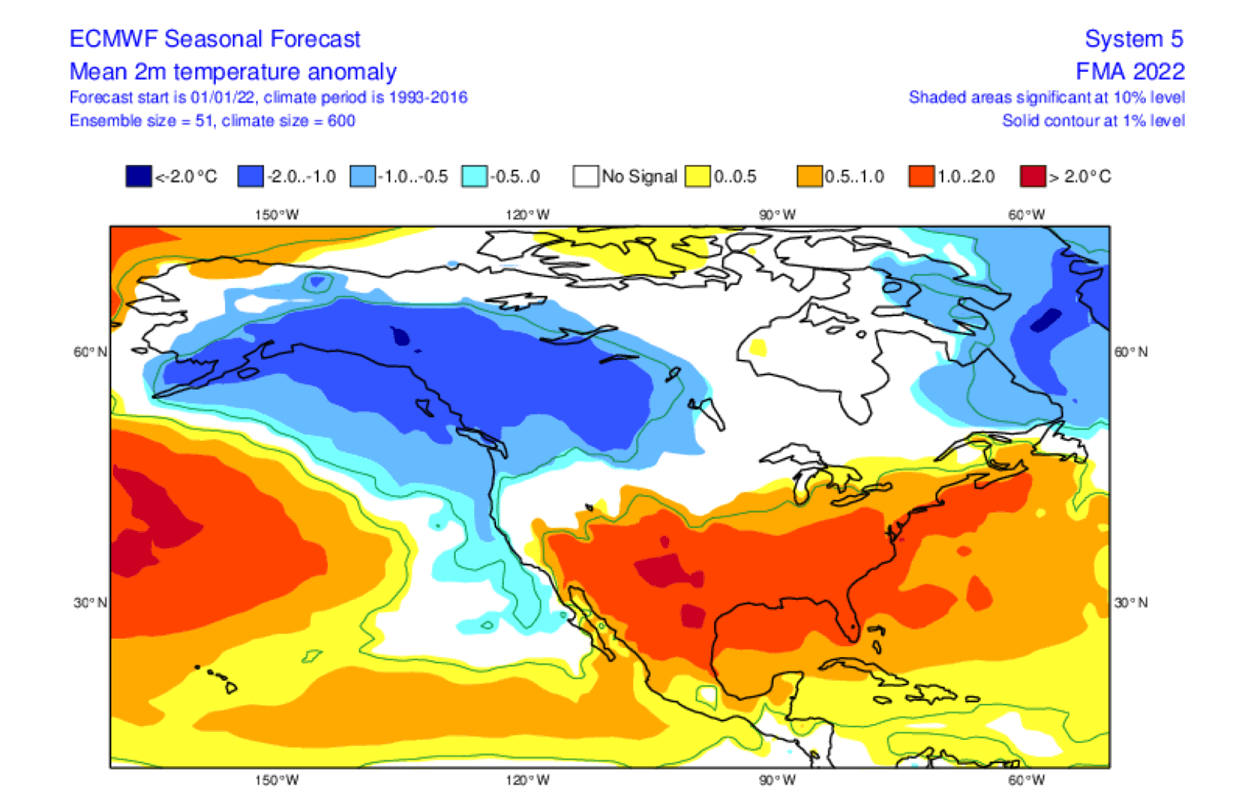
Over North America, we run across the big common cold pool over western Canada and Alaska. That comes from the north catamenia around the strong blocking loftier in the North Pacific. In such a pattern, cold air can chop-chop spread into the midwest and the cardinal/eastern United states of america, as we take seen this wintertime already, despite warmer than normal weather condition being forecast in the seasonal average.
Looking chop-chop at the global precipitation forecast, nosotros see mostly drier to normal conditions over Europe, under a high-pressure arrangement, and wetter in the n.
Over North America, more precipitation is forecast over Canada, which is still mainly snow. More precipitation is also forecast over the northwestern and northeastern parts of the The states. The southern United states is forecast to have normal to drier weather condition, expected for a La Nina flavour.
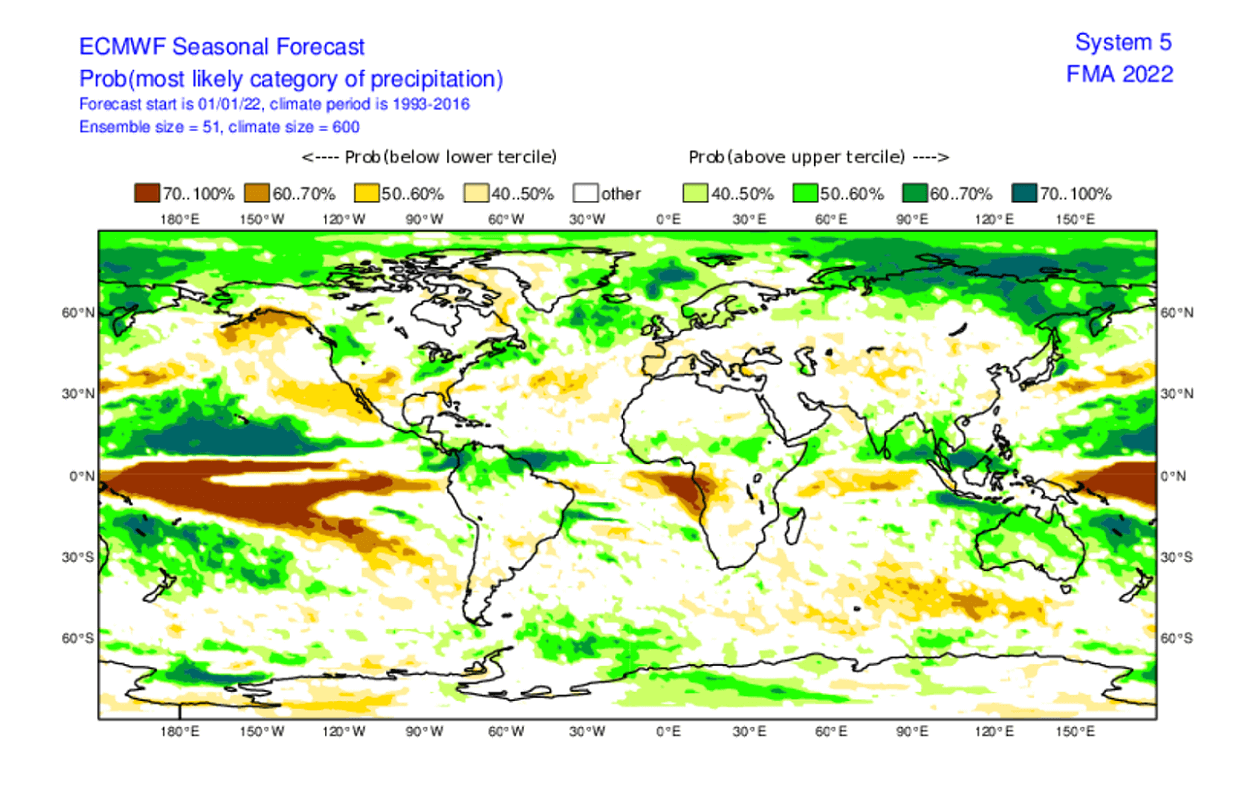
Both the actual weather and the forecast show a articulate sign that La Nina is having a strong presence in the atmosphere. It volition exert its influence on the late wintertime and early spring season in the United states and as well over the unabridged Northern Hemisphere to some extent.
Simply as we go into Bound, we go to the beginning major severe role of the year in the Us. The Tornado Flavour.
ENSO AND United states TORNADO Season
As history shows, La Nina can have an important influence on the Spring tornado season in the United States. And usually not in a adept way. It is also partially responsible for the winter-fourth dimension tornado outbreaks across the United states of america.
Going straight to the signal, nosotros have a very interesting prototype beneath from NOAA Climate. Information technology shows a nice comparison of hailstorm and tornado events during the spring season in the United States, compared between El Nino and La Nina seasons.
It is interesting to see, that in a La Nina spring season, there is a substantially higher frequency of hailstorms and peculiarly tornadoes in the southern and southeastern parts of the United States. It nicely shows the main outlines of the central and eastern parts of the Tornado Alley.

Tornado Alley is a nickname given to an expanse in the southern plains of the central United States, that experiences a high frequency of tornadoes and other astringent weather events each twelvemonth from late winter to belatedly spring.
Merely why are there more than tornadoes and other severe atmospheric condition in the southern United States during a La Nina?
The principal reason is the weather condition patterns that we take seen earlier above, forced by a La Nina event. It promotes a loftier-pressure system in the North Pacific, that usually corresponds to the pressure driblet over western Canada and the northwestern United States.
Below is a graph that shows annual tornado numbers in the United States from 1954 to 2014, which is quite a adept sample size. Looking over the years, nosotros tin can see that from the pinnacle five most active tornado years, 4 were actually La Nina seasons. At least during the main spring function, when at that place are most tornadoes and the ENSO withal has its function in the global circulation.
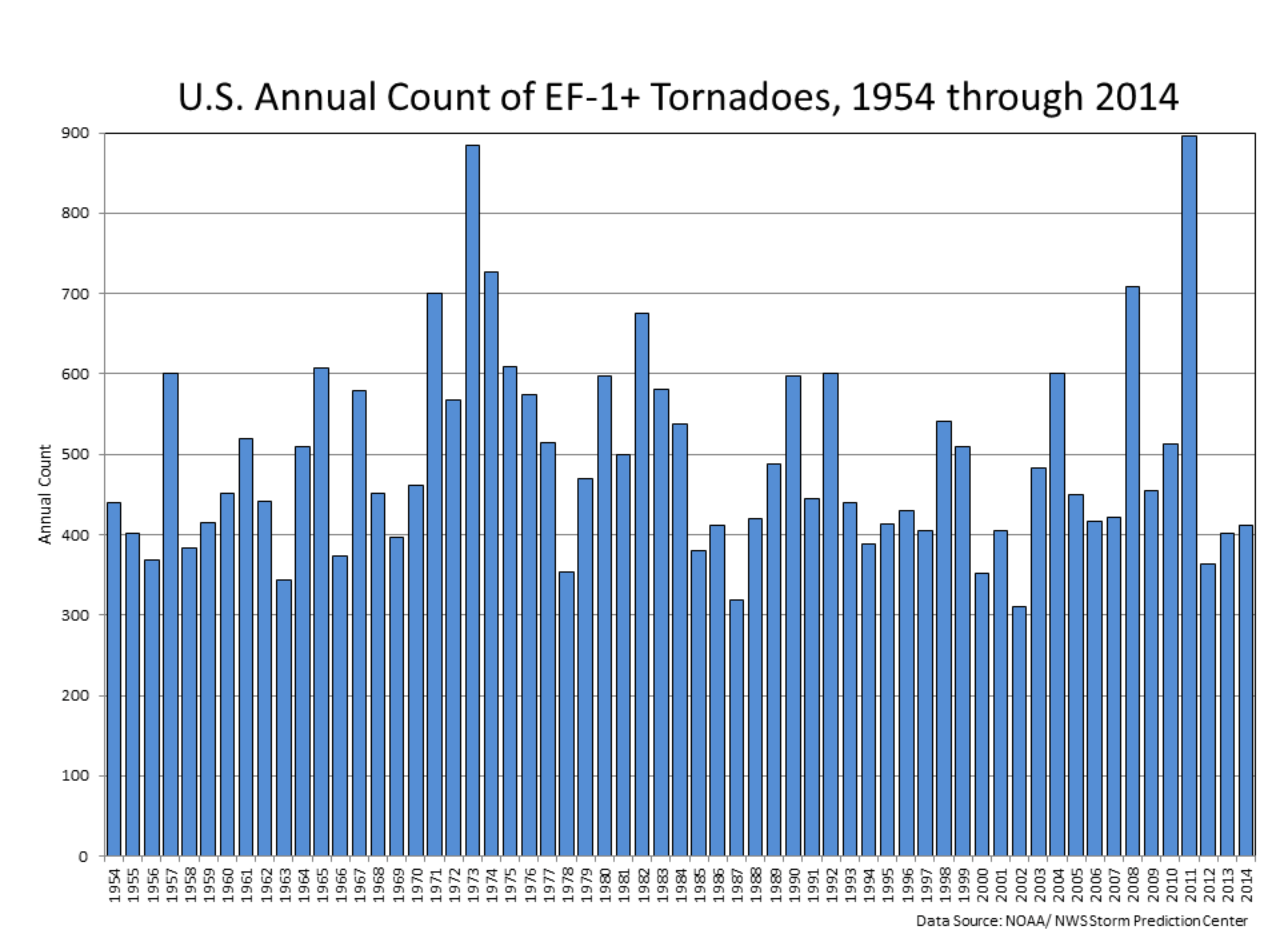
Only that can alter quickly, and equally yous volition now run across, it will happen over the Spring flavour of 2022. Major changes are coming for the ENSO region, that can fifty-fifty resonate into the adjacent twelvemonth.
Body of water CHANGES IN 2022
Below we have a shut-up image of the ENSO regions. You can nicely run across the developing common cold "waveforms", every bit the pressure level patterns are creating stiff easterly surface merchandise winds. They drive the wind-driven ocean surface cooling. Peak cold anomalies are now focused more than towards the eastern regions.

The image beneath shows the temperature bibelot in the ENSO 3.4 region and reveals a stronger cooling since early October due to stronger trade winds. Peak anomalies were reached in late Oct, with another drop-off in December and now in Jan. The cooling is expected to slowly reduce this month, starting the shift into an upwards trend in the coming months (warming).

The reason for the warming can really be seen already, as it is lurking below the ocean surface in the equatorial Pacific.
Looking at the latest high-resolution depth analysis under the ENSO regions, nosotros notwithstanding encounter colder than normal temperatures beneath the surface in the east.

Merely a potent warm pool is coming in from the west at around 100-250m depth. This is known as an oceanic Kelvin Wave, and will slowly push button out the cold anomalies, every bit we head towards late winter.
One style to await at the whole ENSO region temperature strength is by looking at the body of water heat content. This takes the water at depth into consideration as well, not just the surface temperatures.
Beneath we can see the ocean heat content. The cold anomalies accept returned last Summer and likewise peaked in mid-Oct. Lately, the subsurface cold anomalies have weakened, indicating that the La Nina is probable at (or by) its superlative, with the warm Kelvin Moving ridge at present spreading below the surface.

EL NINO IN 2022
You now know well what ENSO and its warm and cold phases are. Then we are going to focus on its development over the warm season, and come across what the most contempo forecasts prove for its 2022 development.
Beneath we have the ocean temperature forecast for the early 2022 Summer season, from the ECMWF. It now shows warm anomalies emerging beyond the equatorial Pacific Sea (black box). This is the likely result of the current warm Kelvin wave at depth, making its appearance on the ocean surface.

This warming is in the eastern NINO3 region, for which we have a long-range forecast below from ECMWF. Information technology shows the La Nina reaching pinnacle cooling in January. The forecast makes a quick return to a neutral stage in Leap, with a transition into warm conditions by Summer.

But note, that the prototype above is for the NINO3 area which covers the eastern region. For an official warm phase to be declared, warm anomalies have to exceed +0.5 degrees in the Nino iii.4 region. And besides, warm anomalies must persist on a multi-seasonal time scale.
The image beneath is a consolidated forecast from multiple N American seasonal models. Information technology besides shows the La Nina reaching the coldest phase this early winter flavor. Going into Spring, we see a return to the neutral phase (between 0.five and -0.5), with an increased chance of an El Nino developing later in 2022.

The about recent ECMWF extended seasonal forecast actually shows the developing warm phase (El Nino), starting in late Summer 2022. ECMWF produces these extended seasonal forecasts every few months. The next extended seasonal forecast release is coming in February 2022, which volition give a much meliorate picture show of what to expect for the next Fall/Winter season.

Merely at the aforementioned fourth dimension, during the warm season, a much larger change volition occur high above the equator in the tropical stratosphere. There we accept a current of air anomaly, so perfectly periodic, that information technology is oftentimes chosen the heartbeat of the atmosphere. And so let'due south go into the atmosphere, and wait at the major changes coming in 2022.
THE HEARTBEAT OF THE ATMOSPHERE
Just like in the oceans, nosotros again have a region that alternates between a positive and a negative phase. But instead of the temperatures, we are now dealing with wind, or rather its direction. This is called the Quasi-Biennial Oscillation, or just simply QBO.
Starting time, we demand to look at the winds over the entire planet. We produced a unique image below, which is quite simple to read. It shows the global west-to-east (zonal) winds, from the south pole (-xc°), over the Equator (0°) to the northward pole (90°).
Positive values indicate westerly winds, while negative values bespeak easterly winds. The graphic shows the winds from the surface up to around 60-65km/37-40mi altitude in the Mesosphere. We have marked a few areas of interest, that really stand up out.

- BROWN box: This marks the strong easterly winds in the Southern Hemisphere. There is currently no polar vortex there, but a loftier pressure system is present, creating a potent wind reversal.
- BLUE box: Here we have our own stratospheric jet stream over the north pole, driven by the Polar Vortex. Information technology is quite stiff and covers pretty much the whole stratosphere.
- Black box: This is the "regular" jet stream as we know it, in the troposphere, at around 8-10km/five-6mi altitude. Nosotros tin can run into that it is quite stronger than the one over the southern hemisphere. That is mainly because we are in the common cold season right now in the northward, so in that location is more than energy involved with the weather systems that drive the jet stream.
- RED box : This is the main expanse of negative values (easterly winds) in the equatorial stratosphere. It is more of import then it might look at first sight. This is the Quasi-Biennial Oscillation (QBO) above the Equator, a regular shift in wind management from west to east.
The Quasi-Biennial Oscillation(QBO), is a regular variation of the winds high higher up the equator. Strong winds in the stratosphere travel in a belt around the planet at the equator. And around every 17 months, these winds completely change direction. This means that every year or then winds high higher up the equator change from west to due east.
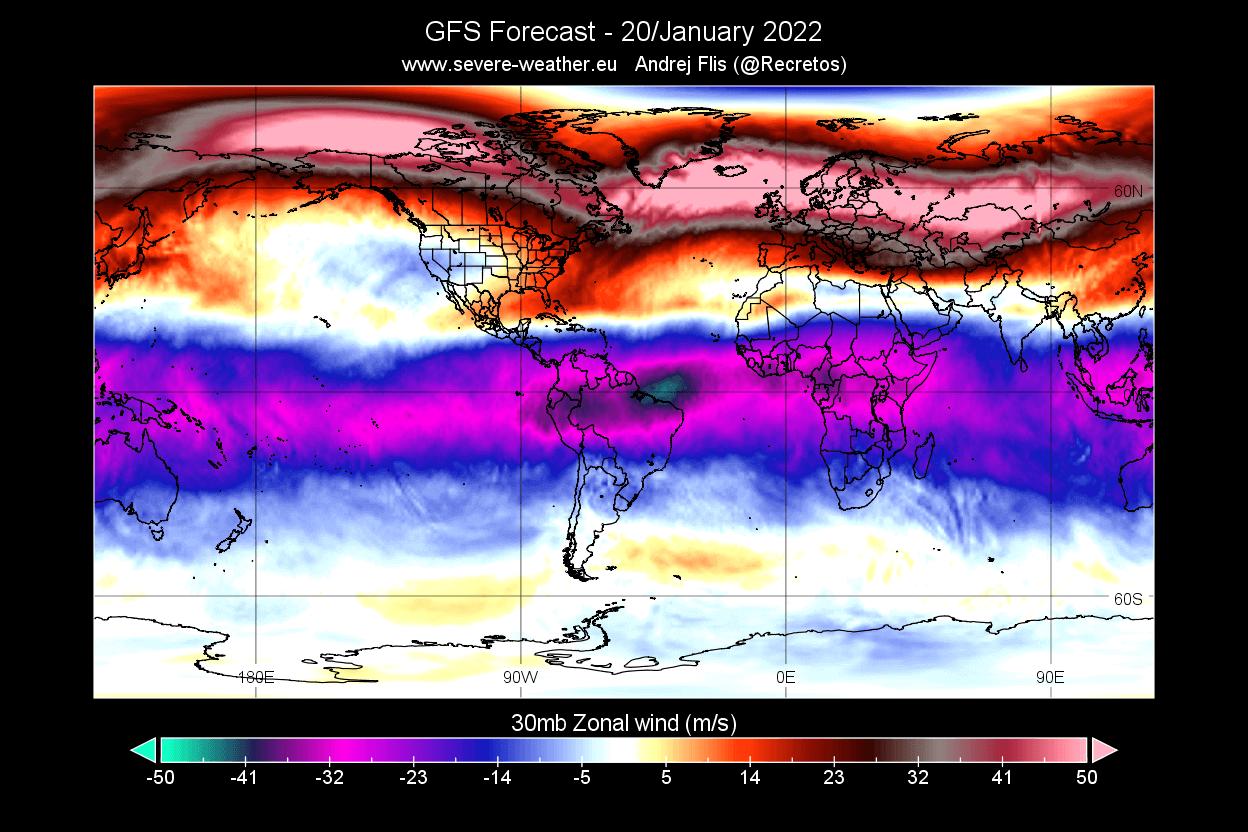
A wind forecast below for the 30mb level (~24km/15mi), shows this easterly current of air stream above the tropical regions. Information technology is currently in negative values, which reveals that easterly winds are prevalent. This means that the QBO is in the east mode. We can run into a large belt of these negative (easterly) winds around the world.
The regular cycle of the QBO can be seen in a quite simple epitome. Below we meet the zonal (west-east) winds in the stratosphere higher up the equator over time. Information technology is obvious right away that this is a very regular shift from due west winds (positive values) to the easterly winds (negative values). Each phase is descending slowly over time, being replaced by a different stage over time.

This shift from west to east winds is so regular, that it gave QBO the nickname "heartbeat of the atmosphere". Each phase slowly descends downwardly over time, from the heart stratosphere effectually 10mb (~30km/eighteen.5mi) downwardly to the superlative of the troposphere effectually 100mb (~17-18km/11mi). Every bit one phase is active, a new one already starts to descend slowly in the higher levels.
Below we have a special graph, that shows the zonal wind anomalies for the by 40 years at around 24km/15mi altitude. Information technology nicely shows just how regularly this wind shifting really is. It truly is like watching an actual center pulse, simply that it is of the atmosphere.

Looking more closely at the by 3 years, we tin see how each phase descended over time. A w phase was active in 2019, and a weak negative in 2020. It was followed by a positive QBO phase during final winter. Currently, a negative QBO phase is active, with a new positive already starting to announced at the very elevation. The epitome below is from NASA assay.

A radiosonde analysis from Singapore also shows the wind direction above the tropics. It reveals the easterly winds effectually the 15-50mb level, confirming the e QBO phase is currently active. But notice on the image below, that on the 10mb level, a new westerly wind phase has appeared, gear up to motility down again during 2022.

Looking at the zonal air current forecast for subsequently this month at the 10mb level, we can see the equator having positive values, which means westerly winds. That is a stark contrast to the 30Mb level, that was shown above, which currently has a full-blown due east QBO in progress. These westerlies college up at 10mb are merely an early indicator of what is to come.

We produced an image from the latest seasonal weather forecast information. Beneath is the forecast for the QBO, showing global zonal winds over the equator. Discover the due west QBO starting to descend down effectually Leap. As we reach Summer, nosotros are fully in a westward (positive) QBO phase and a new negative starting in a higher place for 2023.
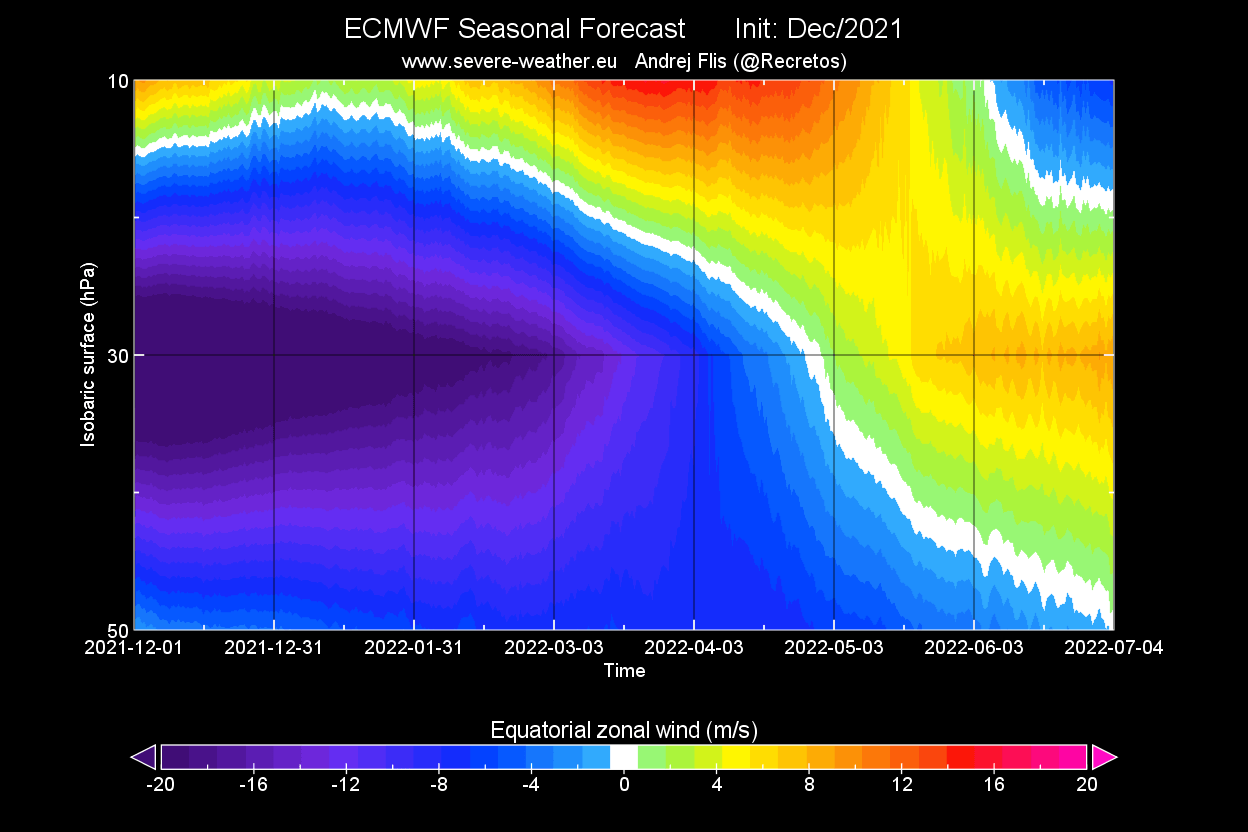
This is an of import change that tin/will affect the global weather downwardly the line in 2022. It is too another major difference with 2021, which featured an east (negative) QBO in its common cold season, that is nonetheless ongoing.
The QBO is an important function of weather evolution in wintertime, as it tin can bear upon the North Atlantic jet stream. The speed of the winds in the Atlantic jet stream can weaken or strengthen with the direction change of the QBO. The jet stream is an important atmospheric feature that shapes our weather.
Depending on the QBO, the risk of winter weather across the Northern Hemisphere can differ, by each of the phases:
- When the QBO is easterly, there is an increased chance of a weak jet stream, sudden stratospheric warming events, and colder winters in Northern and Fundamental Europe and the United States.
- When the QBO is westerly, the adventure of a strong jet, a mild winter, winter storms, and heavy rainfall increases.
At that place is more than than 1 reason why QBO can influence our Winter weather. One very important aspect is of grade the Polar Vortex, which is why we mentioned QBO in this commodity in the kickoff place. The prototype below shows the connectedness between the east QBO and the Polar Vortex in the Dec-January winter period.

It might seem complicated, but the main takeaway is that the QBO helps with the overall tropical forcing, including the ENSO. That is why a QBO does not hateful a fixed weather situation, as a due west QBO response for example tin be unlike during a La Nina or an El Nino.
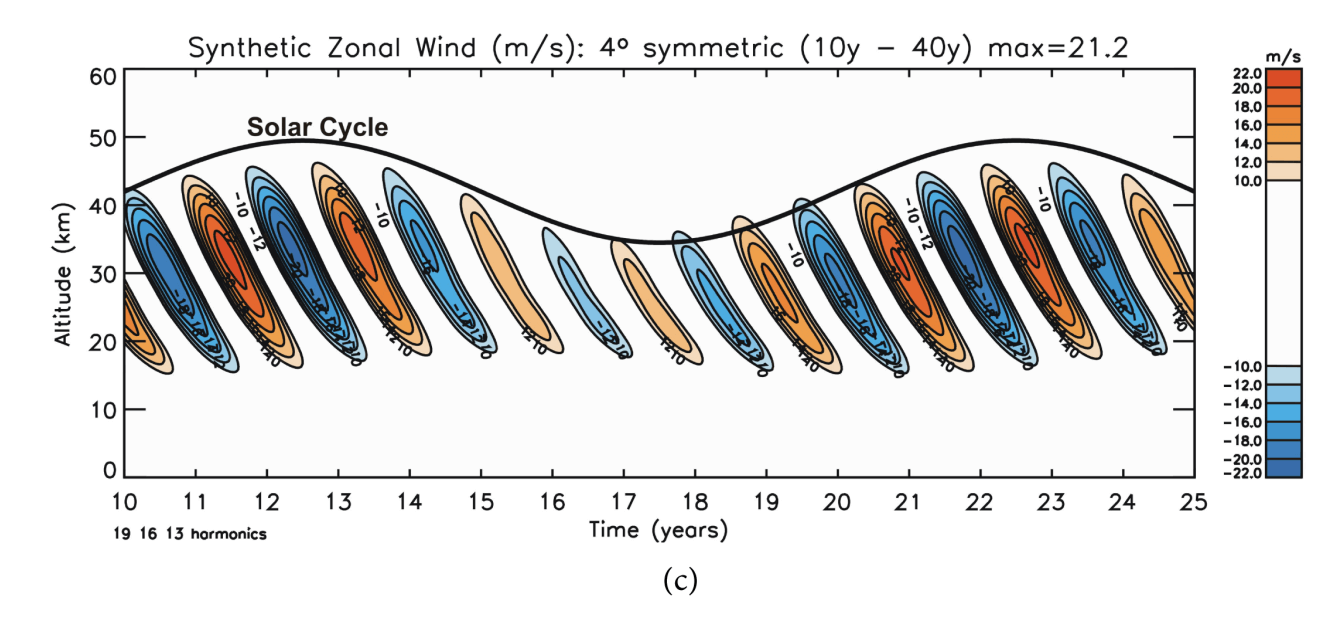
Only, being over the Equator, the QBO is directly continued to the higher levels of the atmosphere, and the solar activity. On the paradigm below, we have a simulation from a contempo report. Information technology shows the fake QBO phases, descending over time, as nosotros showed you above. But information technology is nicely seen how it tin alter with the Solar Cycle.
SOLAR Cycle 2022
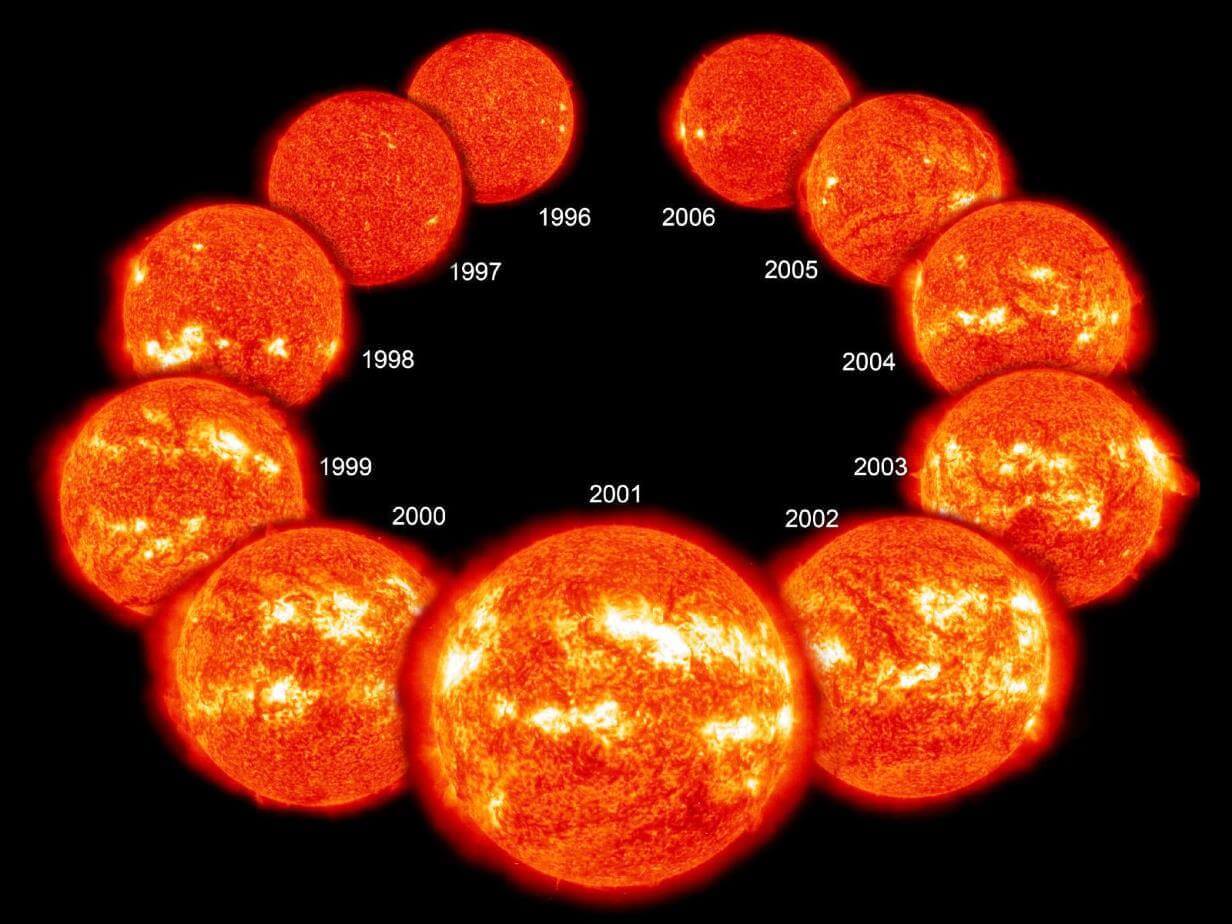
The solar cycle lasts xi years. It is really a wheel of the Sun'due south magnetic field, where the Lord's day goes through a magnetic pole reversal, flipping north and south magnetic poles. That causes all kinds of activity and anomalies in the Sun's magnetic field, which can exist easily appreciable on the Lord's day'south surface as an increase in sunspot numbers.
We tin can see an example of a full solar cycle on the paradigm below, as the sunday goes from a minimum to maximum activity, and back to a minimum.
Below we can run across the solar cycles through the last decades, and the electric current solar minimum. The solar cycle is observed by the total sunspot numbers (SSN). Nosotros reached a final minimum of the solar cycle 24 in 2020, and we began a new solar cycle 25 at that point. Notice how the recent solar cycles are generally weaker compared to the earlier ones.

Looking closer at the last few years, nosotros can see even meliorate how last yr, in 2021, the solar activity picked up over again, now continuing into 2022. At this signal, nosotros will not be able to talk almost a solar bicycle minimum anymore, but a decent path towards a new maximum.

There was a lot of talk well-nigh the sun entering a new grand minimum. A grand minimum means an unusually long phase of low solar activity, and global weather changes equally a result like it happened during the Maunder Minimum. Below we have a prolonged history of solar activity where you tin see the very depression solar activity during the Maunder Minimum. That menstruum was better known as the "little ice age", as global temperatures dropped in response.
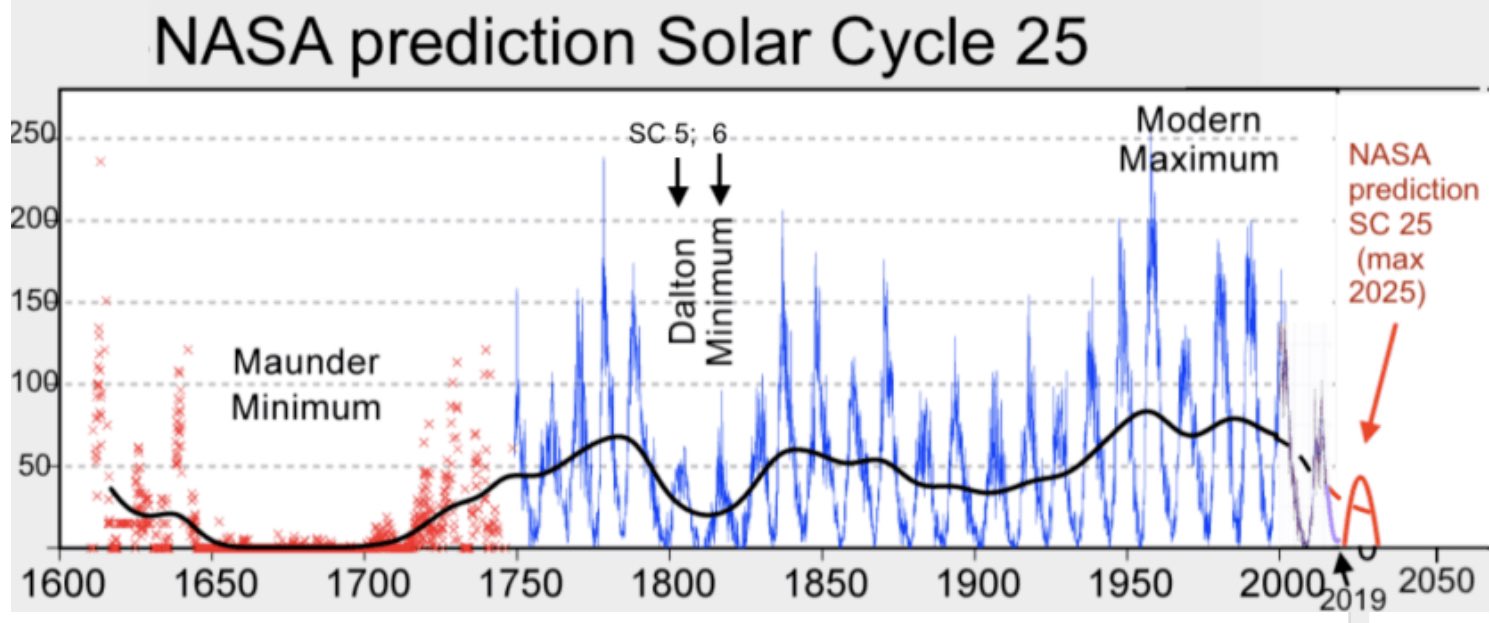
Of grade, a new yard minimum does not start in one year, tho nosotros are seeing each new solar cycle existence weaker than the previous one. This tin can be an indication that we are heading towards a new grand minimum, only information technology can also be a Dalton minimum type, like seen on the image above in the early 1800s.
A Dalton minimum was not every bit low and long-lasting as a Maunder Minimum but also had a global weather response, peculiarly in a global temperature drop. Altho a smaller one compared to the "footling ice age" of the Maunder Minimum.
But, these temperature drops unremarkably happen because of the overall reduced output of the sunday on a prolonged multi-yr scale. For daily weather condition, a single solar wheel does not have a direct influence. Simply every bit we take seen higher up, it is linked to the QBO, and the QBO is linked with the stratosphere and the polar vortex, and then at that place is a linkage to the weather in some way.
All the same, the QBO and the solar activity and don't run the weather on their own. Because that the QBO is in the tropics, there is a strong linkage to the ENSO, that we take mentioned already in a higher place. ENSO also has its ain influence on the wintertime weather patterns, which nosotros will look at next.
Atmospheric condition OF THE EL NINO
Generally, ENSO exhibits an important influence on the Jet stream in the Pacific Sea, and consequently also downstream and upstream around the Northern Hemisphere.
During the El Nino wintertime season, we have a stiff and persistent low-pressure level surface area in the North Pacific. That pushes the polar jet stream further to the northward, bringing warmer than normal atmospheric condition to the northern United States and western Canada. The southerly Pacific jet stream is amplified, bringing storms with lots of precipitation and cooler weather condition to the southern Us.

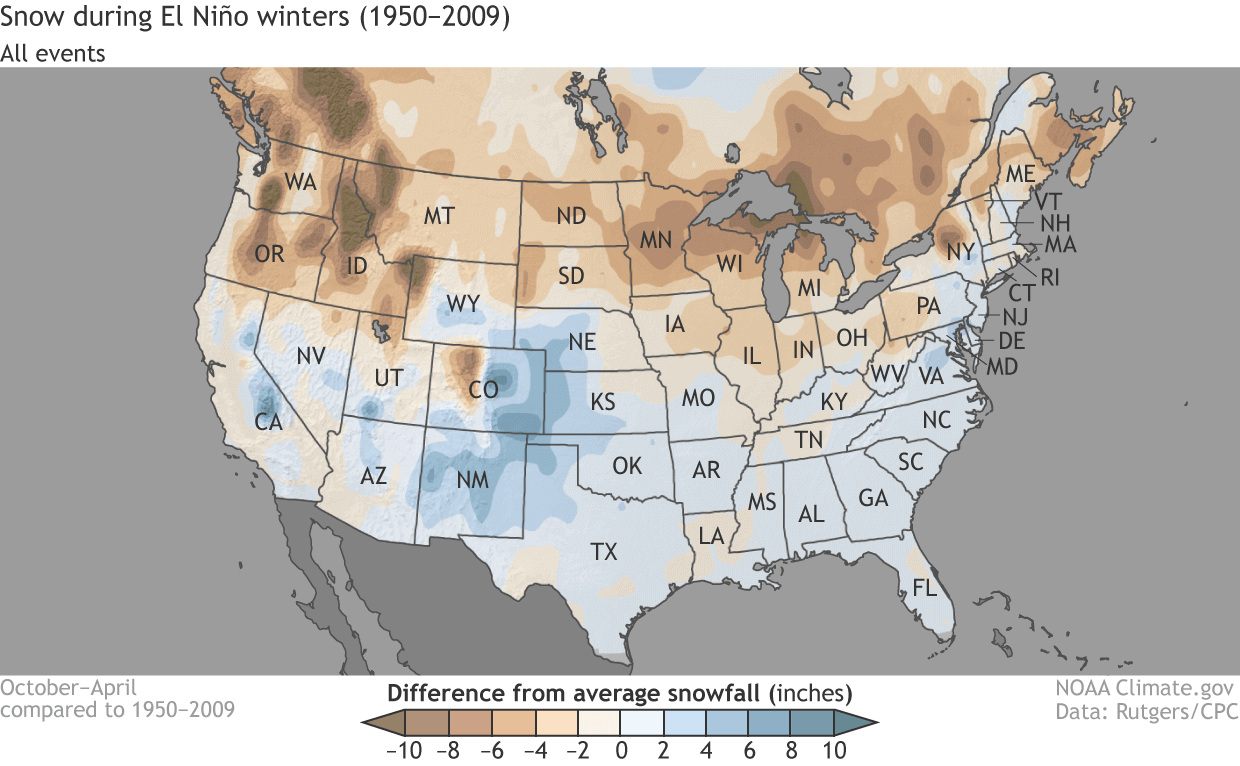
Looking at the boilerplate snowfall for an El Nino winter, we can run into that there is less snowfall in the northern United States during the El Nino seasons. The atmospheric condition are mostly warmer than normal and drier than normal in the northward. But in that location is more snowfall in the west-central The states and in the parts of the eastern United States, where cooler weather condition can be found.
After the jet stream passes over Canada and the United States, information technology moves into the North Atlantic, There it can take many different paths towards Europe.
A lot depends on the existing force per unit area systems in the N Atlantic. This is where ENSO generally maybe loses its direct influence over Europe, as regional systems in the Atlantic are a major interference to whatsoever straight influence.
But information technology ordinarily notwithstanding plays an of import part, as information technology changes the position of the entering jet stream from the west. The outcoming jet stream can then merge with the systems in the N Atlantic, helping to create a whole new weather design for Europe.
Typically, the main problem is that the final outcome is far more unpredictable in this zone than over North America, which feels a much more straight and predictable influence.
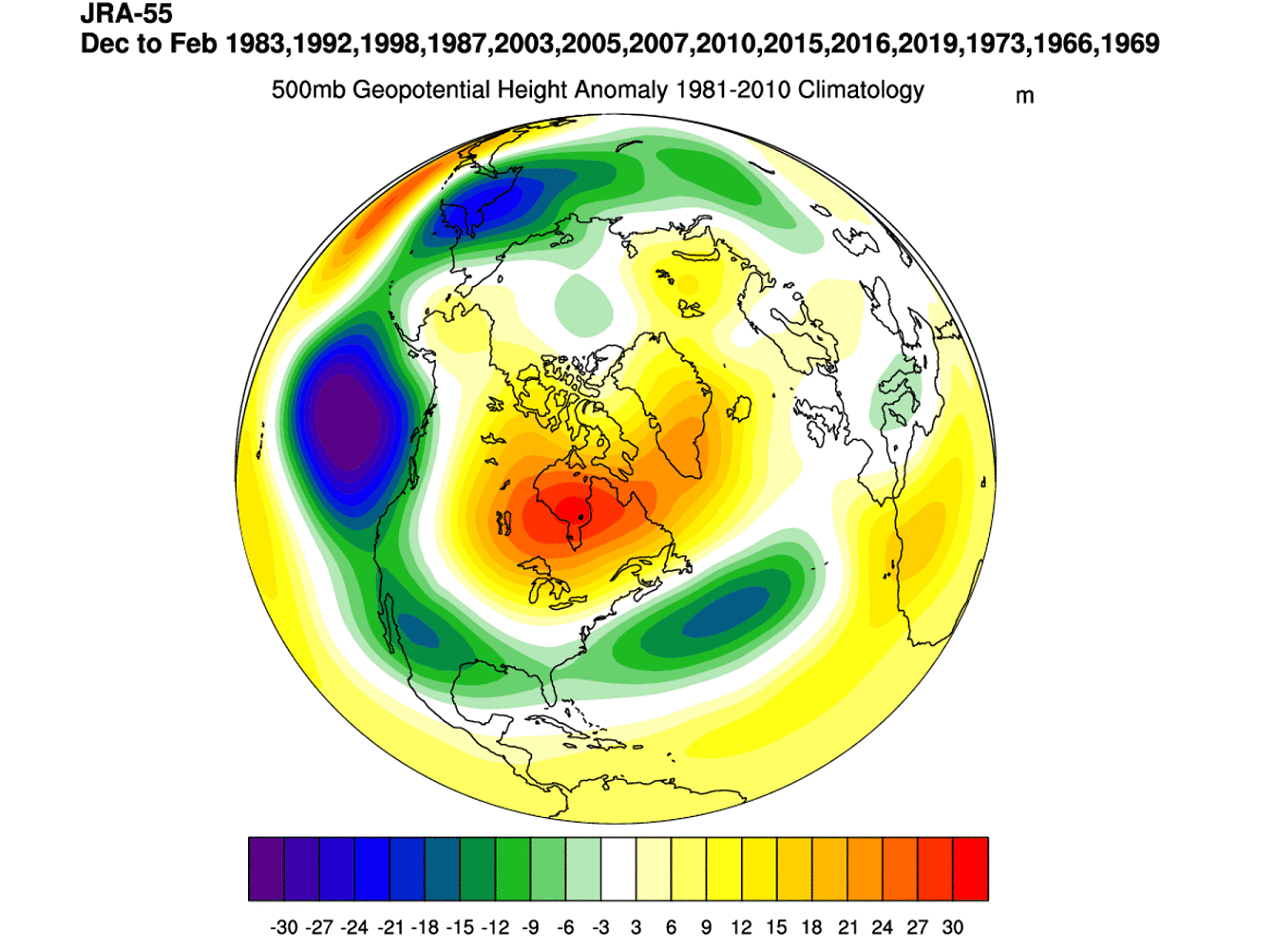
Beneath we can come across the average pressure level blueprint from all the El Nino winters in the past 56 years. We see the typical low-pressure expanse in the Northward Pacific and also over the southern United States. As a contrast nosotros take a high-pressure expanse over eastern Canada and Greenland, going for a negative North Atlantic Oscillation design.
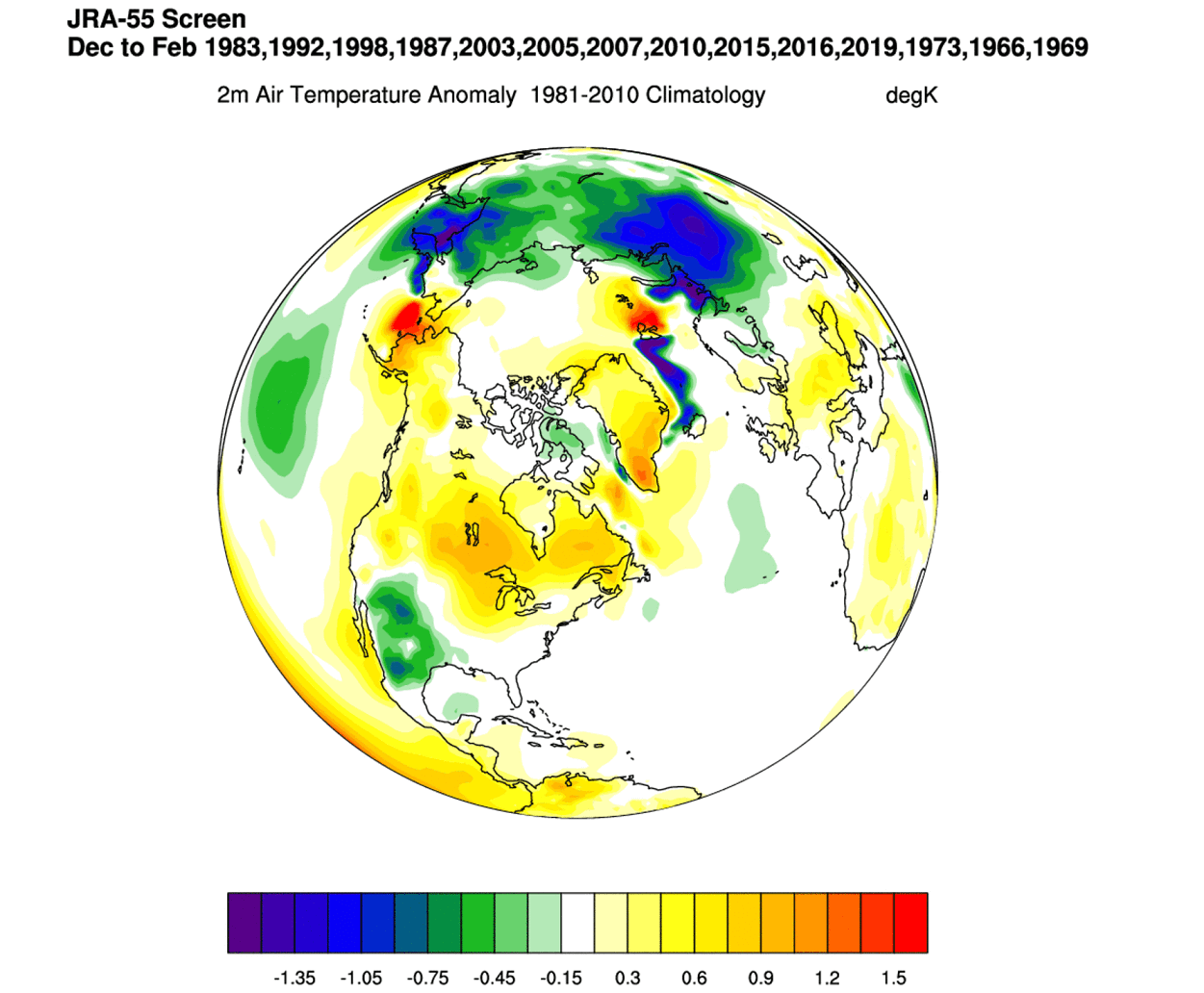
The temperature pattern from the same years shows the warmer than normal temperatures in Canada and the northern United States. Cooler conditions are prevalent in the southern U.s., under the amplified Pacific Jet Stream.
But no two years ever have exactly the same weather, and there are a lot of other factors that likewise play a role. We take already learned nearly the QBO and the Solar Cycle is a combination of other influences.
And so if nosotros now summarize, we have the changing body of water anomalies, going from a cold ENSO to a warm one, an El Nino. Then nosotros also have a major alter in the tropical stratosphere current of air phases, going from east to due west, also modified by the increasing solar bike activity.
Everything comes together in wintertime when the Polar Vortex returns and nicely connects all these factors together. It tin be institute from the ground up into the loftier levels of the stratosphere. Information technology is influenced by the force per unit area patterns of the El Nino from below and interacts with the loftier atmospheric patterns of the QBO.
But what is this polar vortex, and why is information technology such a crucial piece of the weather puzzle in whatever year? Our journey will end with the last key slice of 2022, which is the Polar Vortex, which reigns in the common cold season.
NORTH HEMISPHERE POLAR VORTEX
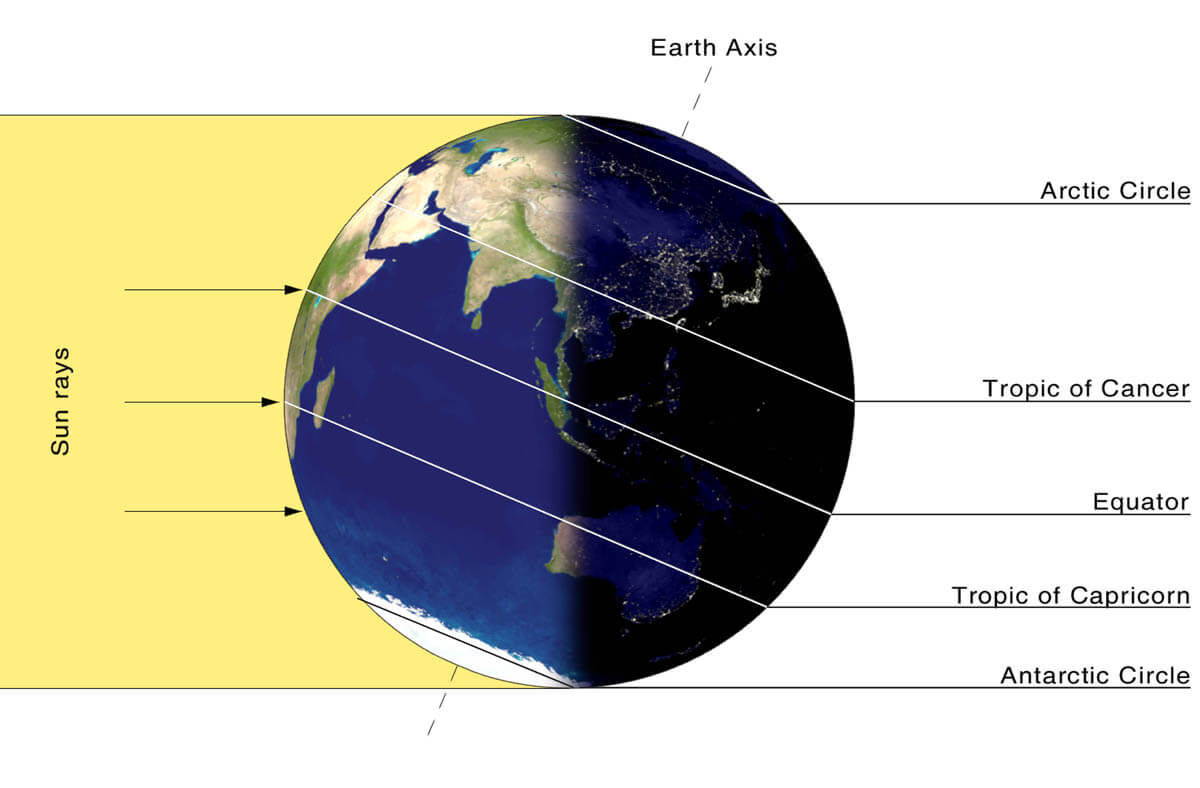
Every year as nosotros head into fall, the polar regions kickoff to receive much less sunlight and sunday energy. This ways that the north pole starts to cool down. But every bit the polar regions are cooling, the temper further south is still relatively warm as it continues to receive energy from the Sun. You can run across the winter solstice on the epitome beneath when the northern regions receive the lowest amount of solar energy, compared to regions further to the southward.
But, as the temperature begins to drop over the polar regions, so does the pressure. With colder temperatures over the pole, the temperature difference towards the southward increases. This also causes a pressure level departure as a big low-pressure (cyclonic) circulation starts to develop across the Northern Hemisphere from the surface layers, far up into the stratosphere. This circulation is known as the Polar Vortex.
While the stratospheric polar vortex is spinning high in a higher place our conditions, it is withal directly continued to the lower function and can shape our daily weather in i way or another, as one large hemispheric apportionment.
The epitome below shows a typical example of the stratospheric Polar Vortex at around 30km/18.5miles altitude (10Mb level) around the middle stratosphere during the winter flavor.
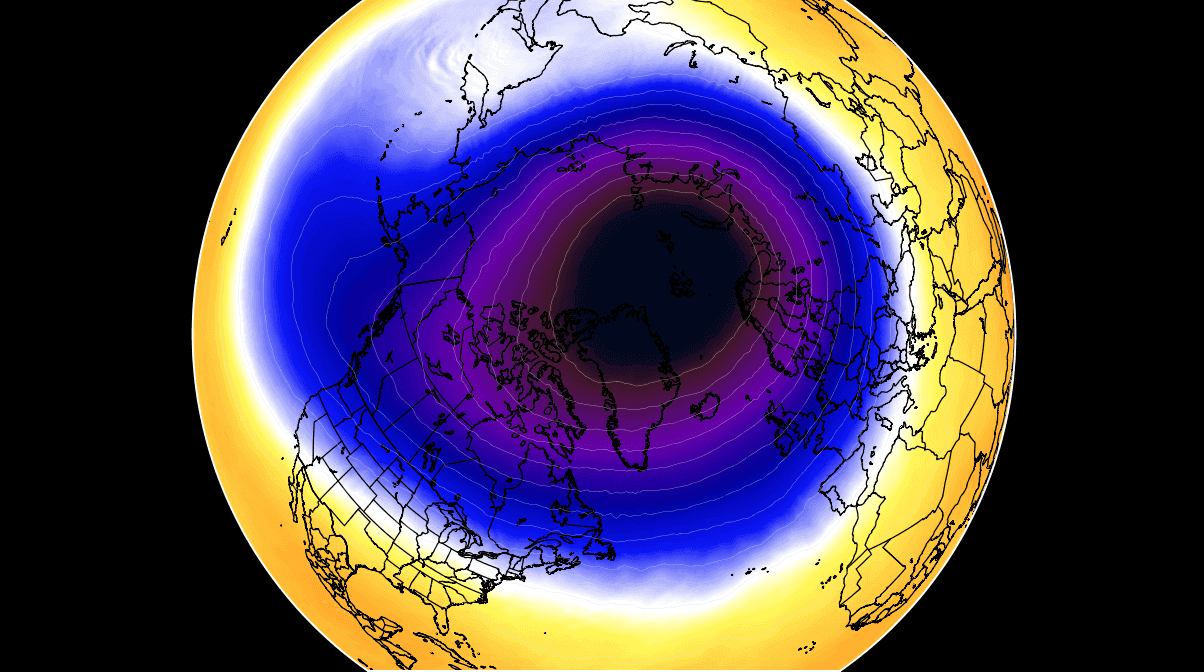
It is basically like a very large depression-pressure arrangement, covering the whole north pole, down to the mid-latitudes. It is strongly nowadays at all levels, from the ground up, but can have quite a different shape and power at different altitudes.
The next image beneath will show y'all the polar vortex at a much lower altitude, around 5km/3miles. It reveals the truthful shape and size of the polar vortex closer to the ground (cold colors). The closer to the surface we get, the more deformed the polar vortex becomes. That is because of the increased terrain/footing influence and the dynamics from many atmospheric condition fronts and systems.
Be enlightened of its cold "arms" extending from the polar vortex into the lower latitudes. That can bring along much colder air and snow. These arms also pack a lot of energy and can create stiff winter storms, either Noreasters in the Usa or a powerful wind storm in the North Atlantic.

Nosotros are currently focusing mostly on the Stratospheric Polar Vortex, as it plays a very important office in the weather development throughout the season. It is known for its strong influence downwards from the stratosphere, in either management, for a cold or warm wintertime.
A strong polar vortex usually means stronger polar circulation fifty-fifty in the lower levels of the temper. This oft locks the colder air into the Polar regions, creating milder winter for almost of the United States and Europe. On the other paw, a Polar Vortex breakdown is just as intense as it sounds. Higher pressure pushes down from the stratosphere into the Polar Circle, weakening the circulation. That tin can push button the colder air out of the polar regions, into the United states and/or Europe. Image by NOAA.
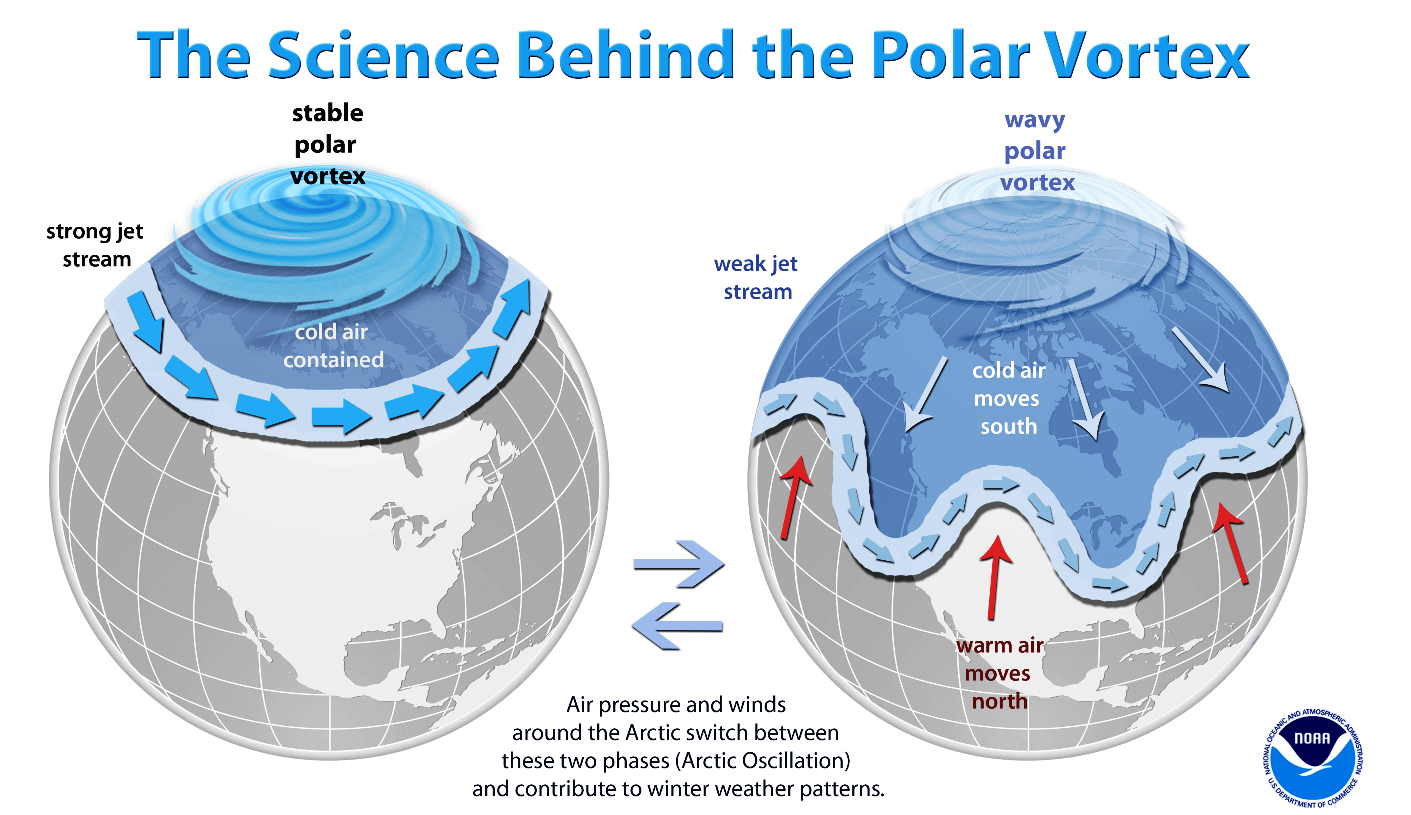
Typically, a polar vortex circulation collapses due to a rise in temperature in pressure in the stratosphere. That is called a Sudden Stratospheric Warming (SSW) event. And every bit the name suggests, it is a sudden rise in temperatures in the stratosphere.
But at that place tin can also be smaller warming waves in the stratosphere, that practise non collapse the polar vortex. Instead, they tin sometimes displace or disrupt the polar vortex enough to weaken its influence on the surface levels. That can allow other drivers to take over more strongly, creating a different weather pattern.
Winter STRATOSPHERIC WARMING EVENT
A major polar vortex disruption/plummet is officially named as Sudden Stratospheric Warming consequence (SSW). It is a sudden ascent of temperatures in the polar stratosphere during the cold season, equally the name suggests. Warming of the stratosphere means that the polar vortex is weakened, and tin can also plummet nether the rising pressure during a prolonged warming event.
The source of the warming commonly comes with the energy from the lower layers, equally potent weather systems can really deflect a lot of energy upward into the stratosphere, disrupting its dynamics.
On the image below you tin can see the vertical wave propagation instance. First, we take strong weather systems that deflect a lot of energy upwards into the stratosphere. Later, that energy tin disrupt the polar vortex, creating a warming effect and collapsing the polar vortex circulation. The collapsed polar vortex sends the energy back downward, changing the surface weather patterns past altering the jet stream location.
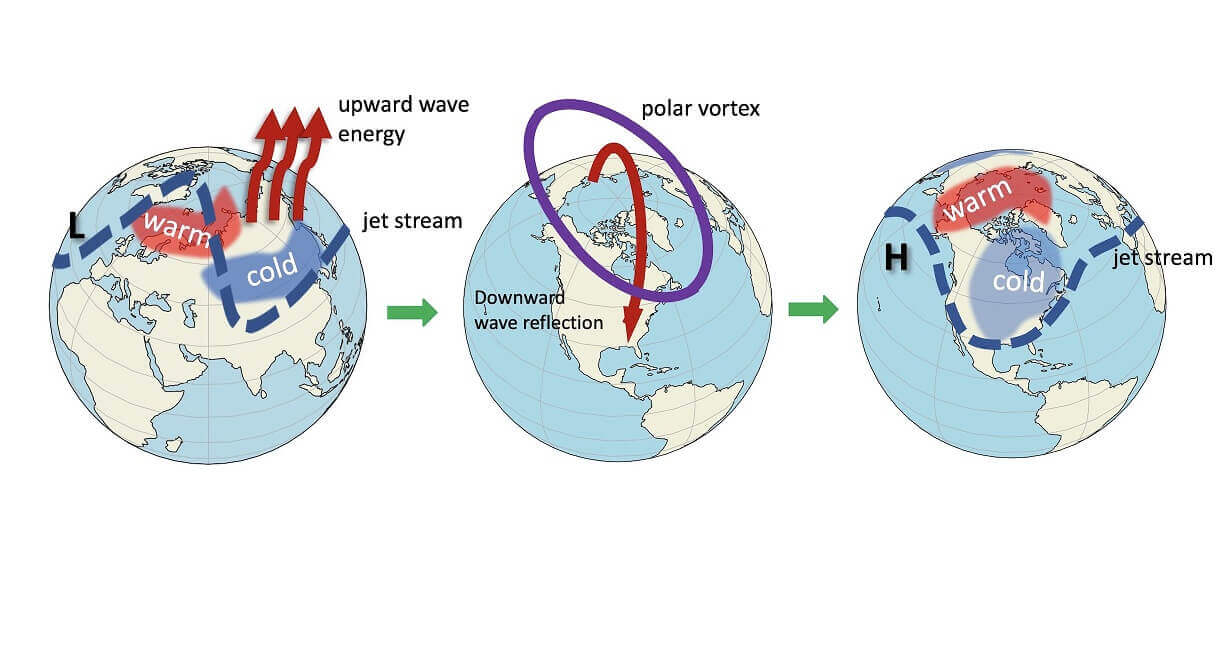
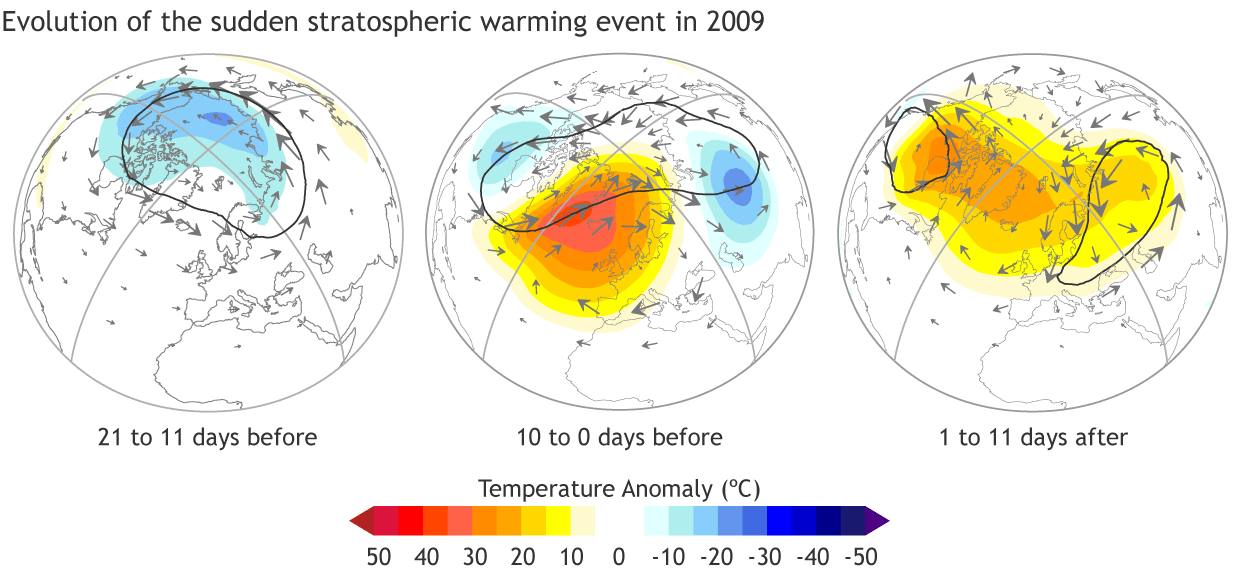
Such disruption creates a concatenation reaction, that can shift the jet stream by edifice a loftier-pressure area over the Arctic circle. That can afterward release the cold arctic air into Europe and the United States. Beneath we have an instance of the start and progress of an SSW result that actually happened in 2009.
Prior to the SSW effect, the polar vortex was colder than normal and had skilful apportionment. Then a high-pressure expanse began building from the Due north Atlantic. Information technology introduced warmer temperatures (stratospheric warming), and information technology likewise broke into the stratospheric circulation. It completely bankrupt the polar vortex apart, sending a wave of higher pressure downward to the surface.
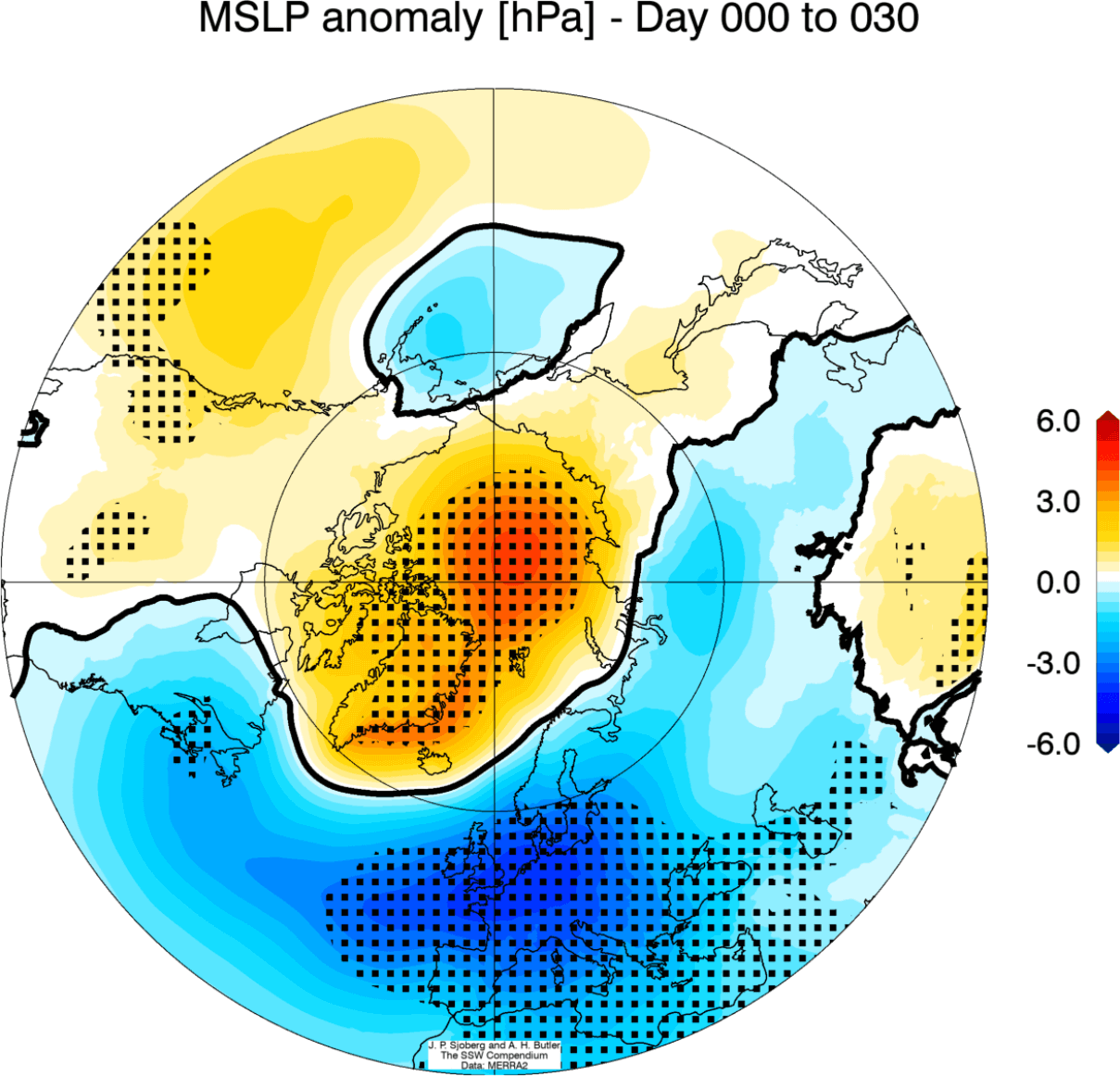
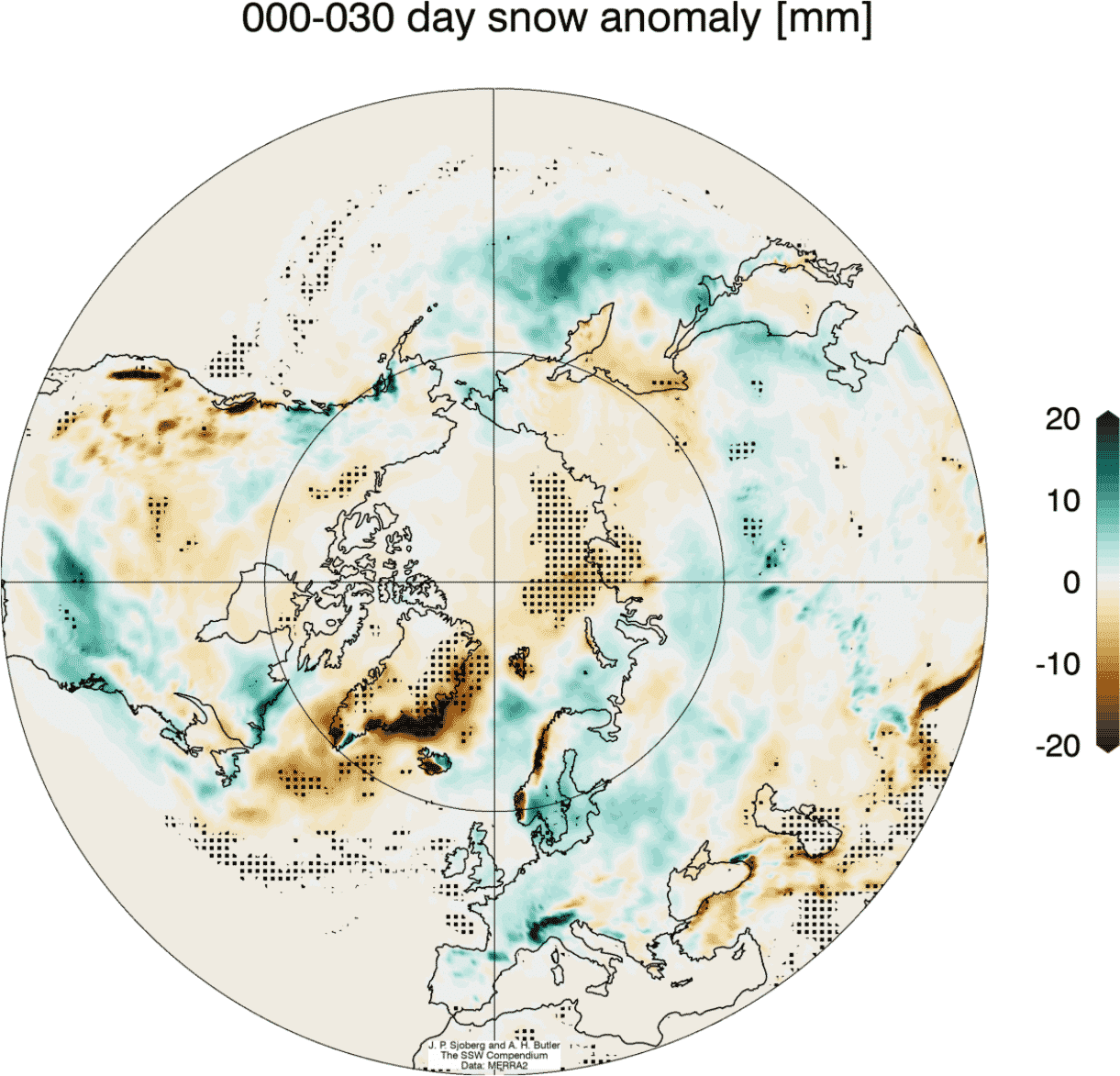
If we combine all Stratospheric Warming events in the past decades and look at the atmospheric condition 0-xxx days after these events, we get an interesting, but perhaps an expected weather picture.
We can see the boilerplate pressure level anomalies below 0-30 days subsequently an SSW result. It shows the pressure ascension over the polar regions, following an SSW event. Force per unit area tends to driblet over Europe and the western Atlantic. This is a heavily disrupted circulation, that helps to create a free path for colder polar air to move out of the polar regions.
Below we have the respective average temperature 0-30 days after an SSW event. Well-nigh of the United States has a colder betoken, including Europe and Siberia. Note: this is an average picture of many SSW events. Each individual warming event is different and does not automatically mean a strong winter pattern by itself. Eastern Canada has warmer than normal weather, as it is influenced by the expanding high-pressure organization.

Looking at the snow anomalies below, we tin can see the above-average snow over much of the eastern United States and besides Europe. This is an expected response afterwards major warming events, every bit the colder air has an easier path towards the south and into these regions, provided that enough moisture is available.
Research shows, that from all the ENSO phases, the El Nino has the highest historical chance of producing an SSW event. That is due to the unique weather pattern information technology helps to set up, which tin can deflect a lot of free energy upwards. Of course, the El Nino is no guarantee that an SSW will occur, but it is more likely to produce ane, based on historical data.
Nosotros will release regular weekly and monthly weather updates for the ongoing winter season and as fresh forecasts and data are bachelor, and then make certain to bookmark our folio. Also, if you accept seen this article in the Google App (Observe) feed, click the like button (♥) there to run into more of our forecasts and the latest articles on weather and nature in general.
SEE Besides:
The Coldest Air of the Winter Season 2021/22 Heads for the Northeast U.S. as Polar Vortex Pushes Another Frigid Common cold Blast from Canada on Sunday
Source: https://www.severe-weather.eu/long-range-2/weather-forecast-2022-outlook-seasonal-usa-europe-changes-ocean-atmosphere-fa/

Publicar un comentario for "When Will the Temperatures Began to Rise Again This Winter"