How Is Indonesia Trying to Prevent Destrution From the Tsunami to Ever Happen Again
Hazards in paradise: Indonesia prepares for natural disasters
past Arielle Emmett
Tuesday, June 5, 2018
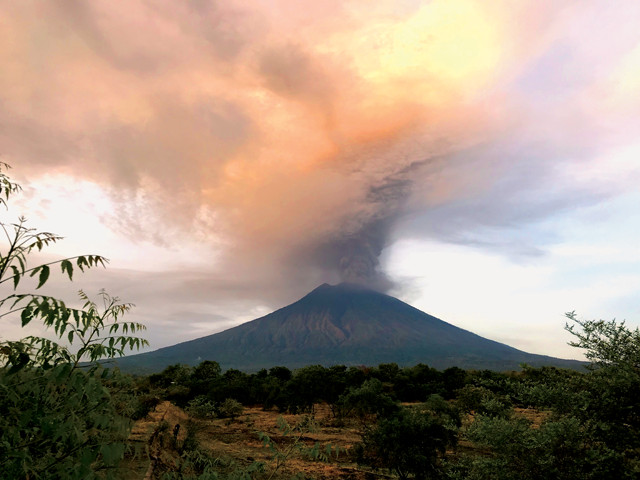
Mount Agung on Bali erupts in November 2017. It is ane of nearly eighty volcanoes in Indonesia that have erupted in recorded history. Credit: Michael W. Ishak, CC BY-SA 4.0.
With a little imagination, it's non difficult to run across a natural chance map of Republic of indonesia as a dartboard with many bull's-eyes. Throw a dart anywhere in the vicinity of the 18,000 islands that make up the Indonesian Archipelago, and it will almost certainly land close to more than one active volcano, and virtually areas severely impacted by by earthquakes and tsunamis, as well as dozens of fires, floods, tornadoes and landslides, which all routinely disrupt this country'due south lush beauty.
Indonesia sits atop a tectonically complex region along the Pacific Ring of Fire — the volatile region of earthquake and volcanic activity that encircles the Pacific Ocean. And, by virtue of the archipelago's equatorial location and its array of physiographically diverse islands, dissimilar parts of the country are subjected to a broad diversity of weather, from drenching monsoon rains to prolonged dry spells.
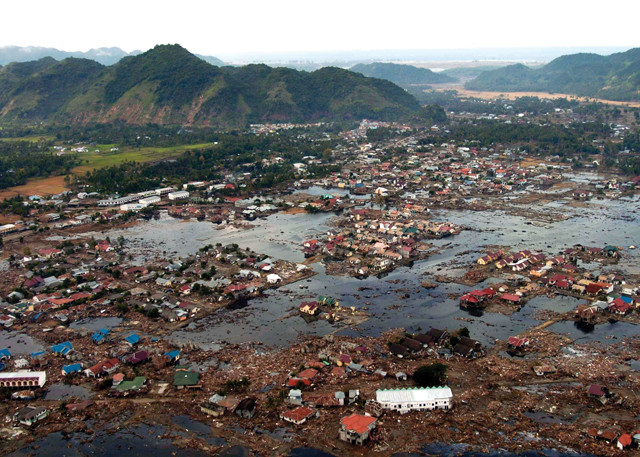
A flooded suburb of Banda Aceh, at the northwest tip of Sumatra, following the Dec 2004 Indian Ocean earthquake and tsunami, which inundated large swathes of coastline in Indonesia, Thailand and elsewhere around the region. Credit: U.Due south. Navy photograph past Photographer's Mate 2nd Class Philip A. McDaniel.
I visited the islands of Java, Sumatra and Bali in December 2022 — my third visit to Indonesia in three years — eager to grab upwardly on friendships and learn how carefully the country was monitoring its earthquake, tsunami and volcanic hazards. On my heed were the catastrophic 2004 Indian Ocean convulsion and tsunami that struck simply west of Sumatra's Aceh Province, claiming the lives of more than 170,000 Indonesians and roughly 270,000 people effectually the region.
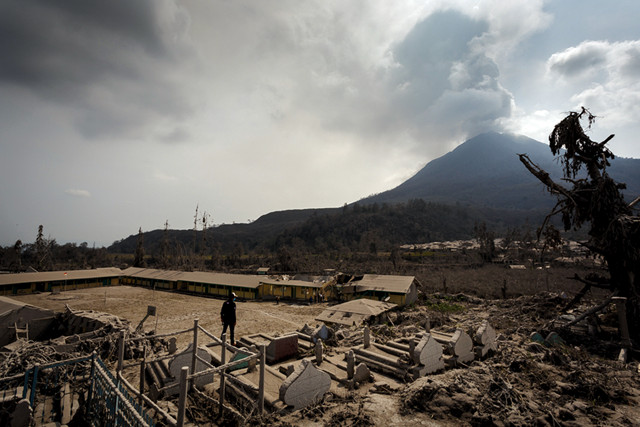
Volcanic ash covers a school and cemetery near Sinabung in Jan 2014. Sinabung began erupting in 2010 after a centuries-long dormancy, and has been very active since 2013. Credit: Rendy Cipta Muliawan, CC BY 2.0.
In recent years, the Indonesian government, along with other groups like the Earth Observatory of Singapore and the U.S. Pacific Seismic sea wave Warning Center, has been introducing technologies to improve hazard forecasting, warning and mitigation. Amid these technologies are GPS systems enabling precision geodetic measurements of plate tectonic movements and stresses; tidal gauges; gas-sniffing drones and temperature sensors for volcanic monitoring; and a new set of integrated databases and communications systems providing gamble detection and visualization, decision support, and convulsion and tsunami warning protocols.
But how effective are these technologies in helping safeguard the country'due south populace? Indonesia is a country with 55,000 kilometers of coastline and more 266 million inhabitants living on 6,000 islands, many of which are amidst the most remote in the world, where cellphone and internet coverage is rare. I wanted to understand whether the government'southward efforts to communicate well-nigh hazards were reaching its far-flung residents, and if disaster preparedness based on folklore and "local wisdom" might be every bit important — or more and then — than monitoring and warning technologies.
Weather and Geology Hazards
Few people outside the region understand just how regularly natural disasters occur throughout Indonesia'south v,000-kilometer-wide archipelago. More than two,000 serious disasters are reported each year, 90 percent of which are weather-related — generally the result of flooding rains, tornadoes, fires and mudslides. In 2017, Indonesians reported 787 floods, 716 tornadoes, 614 landslides, and 96 woods and ground fires (called-for peat lands and rainforests to brand room for big palm oil plantations and smaller farms is a popular exercise, particularly in Sumatra). Indonesians also reported 19 regional droughts, two volcanic eruptions — at Mount Sinabung on Sumatra and Mountain Agung on Bali — and 11 tsunamis. Overall, iii.iv million people were displaced that year by these natural disasters.
Republic of indonesia experiences roughly 4,000 earthquakes a year, 70 to 100 of which are magnitude five.five or higher, along with one or two highly subversive quakes, some reaching or exceeding magnitude 8. Hazard maps created by the Indonesian Agency for Meteorology, Climatology and Geophysics, known as BMKG (Badan Meteorologi, Klimatologi, dan Geofisika), bear witness that earthquakes and tsunamis are particularly frequent on those islands directly adjacent to the boundaries of the tectonic plates that see in Republic of indonesia's midst — specifically the Indo-Australian, Pacific, Philippine Body of water and Sunda plates — which are continuously moving and straining against one another.
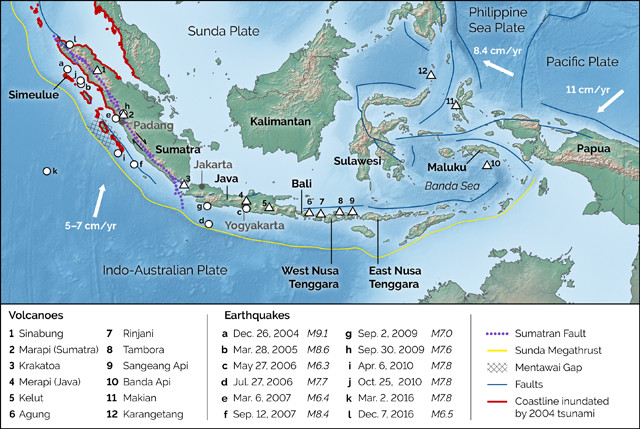
Earthquakes, volcanic eruptions and tsunamis often impact Indonesia as a result of the archipelago's location amid many colliding tectonic plates. This map shows some of the major earthquakes that have struck Republic of indonesia in recent years, along with the overflowing zone of the massive December 2004 seismic sea wave and a sampling of the land's many active volcanoes. Credit: K. Cantner, AGI.
Off the western and southern coasts of Sumatra, Coffee and Nusa Tenggara, for example, the Indo-Australian Plate subducts under the Sunda Plate at a speed of 5 to 7 centimeters per year, building upwards stress that's occasionally released as large earthquakes. A chain of active volcanoes — including Sinabung and Krakatoa among others — traces this plate boundary. To Indonesia'due south northeast, meanwhile, the Philippine Sea Plate collides with the Sunda Plate to its due west and the Pacific Plate to its east. And between all of these major plate collisions, just east of Java, a so-called "suture zone" upward to 2,000 kilometers wide comprises several smaller plates that move against each other at relatively high speeds. Earthquakes happen along multiple subduction zones and other faults in the suture zone, likewise, specially effectually the "spice islands" of Maluku, Sulawesi, Papua, and smaller islands in the Banda Body of water.
With all of this tectonic activeness, the state also has 78 volcanoes that accept erupted in recorded history. Most famous among them, perhaps, are Tambora in West Nusa Tenggara and Krakatoa, situated between Sumatra and Java, which erupted catastrophically in 1815 and 1883, respectively. In recent times, a 2010 eruption at Mount Merapi outside Yogyakarta in Java spewed plumes of ash, lahars and pyroclastic flows, along with a cloud of ash and sulfur dioxide that reached more than 15 kilometers into the atmosphere over the Indian Ocean, prompting the evacuation of 350,000 people. However, many chose to remain behind or return home while the eruption was withal going on, and 350 people died.
In northern Sumatra, Mount Sinabung, which had been dormant for 400 years, began erupting in August 2010 and has been very agile since 2013. Major eruptions in 2017, and again this by Feb, chased residents from the mountain, and Indonesia's National Disaster Management Potency, known as BNPB (Badan Nasional Penanggulangan Bencana), adamant that all residents had to be resettled permanently due to the volcano's volatility. Meanwhile, Mountain Agung, on Bali, came to life in belatedly November 2022 later a hiatus of more than than 50 years since its final explosive eruption in 1963. Cheers to advances in monitoring almost Agung, plenty of warning signs were detected, enabling disaster personnel to gild evacuations before the volcano actually blew, and there were no casualties. In 1963, by dissimilarity, 1,500 people perished as a result of the unexpected eruption.
Technical and Cultural Challenges
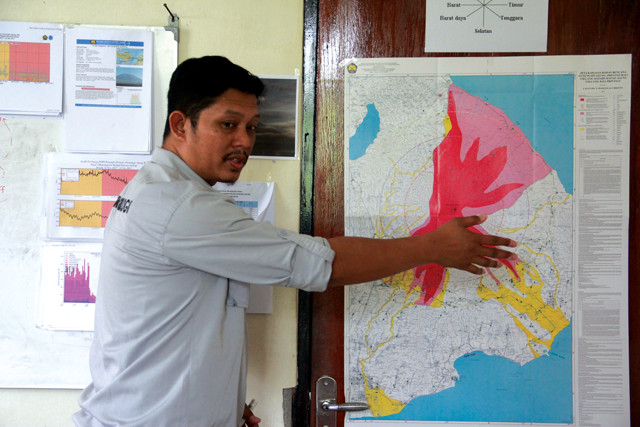
Devy Kamil Syahbana, a volcanologist with the Indonesian Eye for Volcanology and Geological Take a chance Mitigation, talks well-nigh how the Nov 2022 eruption of Mount Agung forced the evacuations of rural residents living near the volcano. Credit: Wibi Pangestu Pratama.
"Because of the technical changes in volcanic science, we have had fewer victims in the past 20 years," says Devy Kamil Syahbana, a field specialist with the Indonesian Heart for Volcanology and Geological Hazard Mitigation (Pusat Vulkanologi dan Mitigasi Bencana Geologi Badan) who monitors Mount Agung on Bali. "Two decades agone, nosotros didn't have broadband seismometers or multi-gas analyzer spectroscopy to requite us insights into the physical processes within a volcano," he says. GPS satellites and temperature sensors were also defective in the toolkit of Indonesian scientists at that fourth dimension. "At present, volcanic eruptions are among the near predictable of geological disruptions," Devy says. Seismic activity is another story. "Yous can't predict earthquakes, and that hasn't inverse."
Tsunamis present a different claiming. Only curt warning times are available with current tsunami monitoring setups: generally between 10 and 60 minutes. And although disaster forecasting and alarm technologies tin help, none are perfect. In an incident that attracted international media attention, a March 2022 magnitude-7.eight earthquake that struck in the ocean roughly 800 kilometers southwest of Padang, Sumatra, resulted in tsunami warnings for parts of Republic of indonesia, but no seismic sea wave ever arrived. The tsunami alarm caused widespread panic in Padang, a coastal city in western Sumatra where tsunamis are a major threat. Thousands of citizens fled to college footing earlier the warning was canceled two hours later.
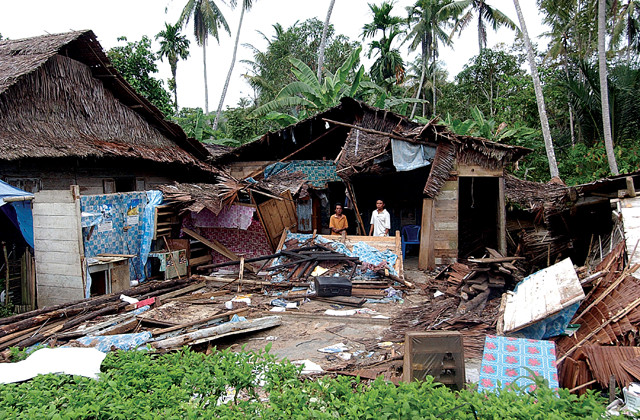
Two men stand amid droppings after their home in a village on the island of Nias, due west of Sumatra, was demolished past ground shaking during a magnitude-viii.6 convulsion in March 2005. Credit: U.S. Navy photo by Photographer's Mate second Form Jeffrey Russell.
While the temblor set off alarms in several unlike international seismic sea wave warning systems, including Indonesia'southward ain, both local disaster specialists in Sumatra and national specialists in Dki jakarta were confronted with alien reports. One of the big problems was a complete lack of data coming from 22 ocean buoys deployed between 2006 and 2010 due west of Sumatra past a team of High german and Indonesian scientists to detect oncoming tsunamis. All of these buoys reportedly failed to piece of work properly during the March 2022 incident.
"There were 22 buoys, and as of [2016], the last of them were non working due to them breaking downward, or from theft or vandalism," says Sutopo Nugroho, director of information for BNPB. Nugroho acknowledges the need for the buoys, just says the land doesn't "have funding for maintenance or to replace them."
When the buoys were showtime deployed, "they didn't work very well," says Jörn Behrens, a professor of mathematics at the University of Hamburg in Germany who was involved with the High german-Indonesian seismic sea wave warning arrangement from 2006 to 2010. "Technically, the buoys did provide information, but they were placed too shut to the potential tsunami sources," he says.
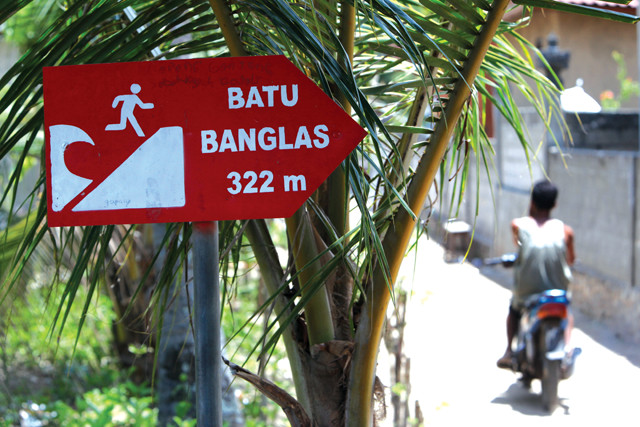
A tsunami chance sign directs people toward high ground on Nusa Lembongan Island about 10 kilometers offshore Bali. Tsunami alert times in Republic of indonesia are often short because of the close proximity of many islands to sources of major earthquakes, such every bit the Sunda Megathrust. Credit: ©iStockphoto.com/urf.
Indonesian islands are very shut to earthquake sources similar the Sunda Megathrust, the five,500-kilometer-long subduction zone off Sumatra and Java that was the source of the cataclysmic 2004 earthquake and seismic sea wave. The buoys' placement results in little delay between the detection of an convulsion and the potential generation of a seismic sea wave wave. This makes it difficult for scientists to translate two dissever data streams coming from the buoys: one measuring seismicity (detected past ocean-lesser pressure sensors attached to the buoys) and some other measuring dissonant wave heights at the h2o's surface. "We couldn't utilize the data except to say something severe had happened," Behrens says. In the Pacific Ocean, by contrast, seismic sea wave buoys are placed farther out in the body of water and away from tsunamigenic faults, so there is a fourth dimension delay betwixt seismic activity and the detection of a tsunami. Behrens believes the electric current dysfunctional buoys need to exist replaced with a improve-designed seismic sea wave warning system.
Although seismologists and disaster mitigation authorities in the country accept hoped to procure new technology to more quickly detect incipient threats, an array of nontechnical factors impedes progress. Alien agendas among multiple disaster agencies sometimes get in the manner, equally do express funding for disaster monitoring and response, which influences both applied science choices and borough responses. And on some islands, local officials often ignore warnings from disaster agencies, thinking the regime is too often "crying wolf."
"The claiming is the depression capacity of local governments; they don't put disaster risk awareness into their agenda," Nugroho says. Many of Indonesia's most remote villages likewise lack reliable communications and route infrastructure, so that residents may non hear sirens or radio warnings.
Moreover, in some circumstances, individuals have motivations that — knowingly or not — are at odds with monitoring efforts. Off western Sumatra, for example, fishermen and pirates accept reportedly stripped the tsunami buoys, which cost more than $300,000 apiece, of sensitive electronic parts to sell. Others, meanwhile, have used the buoys to ballast their boats, damaging the buoys and disrupting their information manual.
"Y'all have to face the situation that these fishermen have to make a living and back up their families, while a tsunami might occur in their surface area every hundred years or so," Behrens explains.
Efforts to Improve
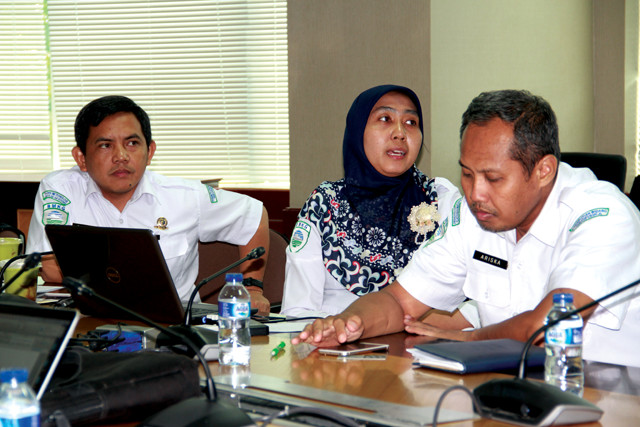
Indonesian Bureau for Meteorology, Climatology and Geophysics (BMKG) convulsion and seismic sea wave data specialists (left to right) Dr. Daryono, Weniza, and Ariska Rudyanto review data from the InaTEWS warning system. Credit: Wibi Pangestu Pratama.
Specific predictions of the timing and severity of natural disasters are not possible, simply Indonesian disaster direction agencies are making substantial progress in providing warnings of potentially dangerous events. Some disquisitional organization pieces are withal missing in these efforts, yet.
"Before 2012, even with the convulsion disasters of 2004 and 2009, Indonesia didn't have adept monitoring or warning systems for disaster management," Nugroho says. "If we had an earthquake or volcano, and lots of citizens accessed our websites for information, too often the sites crashed," he says.
In the by half-decade, notwithstanding, Jakarta adopted a single, internationally recognized platform for monitoring and responding to natural hazards of all sorts in virtually-real time. The high-tech installation is known as InAWARE 6, a variant of DisasterAWARE, a multihazard alarm and risk assessment system created at the Pacific Disaster Centre (PDC) in Hawaii with support from the U.S. Agency for International Evolution. Information technology is as well deployed in Thailand, Vietnam and Nepal. The Indonesian version of DisasterAWARE, however, has been modified for scenarios that take the dispersed Indonesian islands into business relationship.
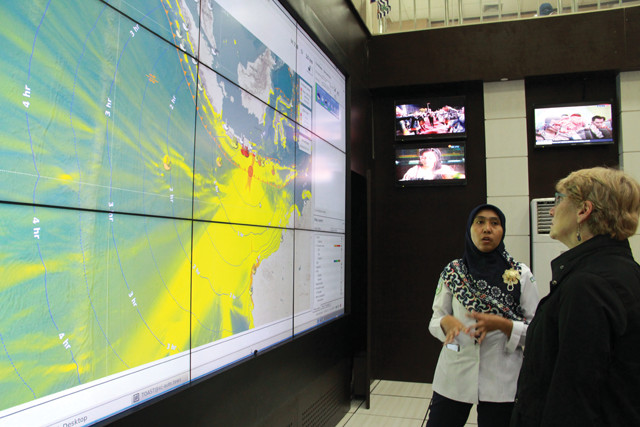
BMKG specialist Weniza explains the agency'south InaTEWS warning arrangement to the author. Credit: Wibi Pangestu Pratama.
At BNPB headquarters in Jakarta, a constantly changing InAWARE touchscreen displays the size and severity of Indonesian natural hazards, with colored bull'due south-eyes indicating locations of earthquakes, volcanoes, fires, mudslides, tornadoes, storms and tsunamis. Using the platform, decision-makers tin can analyze data coming in from multiple regional and global feeds, such as seismic data from the U.S. Geological Survey, weather data from the National Oceanographic and Atmospheric Administration, and tsunami information from the Indian Body of water Tsunami Alarm System and Indonesia'southward BMKG.
"The claiming that remains is getting data to people in the 'last mile' — people who need to know nearly it," says Chris Chiesa, deputy director of the PDC. "Even if the alarm system worked perfectly and instantaneously, even if SMS [text messaging] works i second after the ground shakes, for a nearshore earthquake [and tsunami] event, you'd have trouble a couple of kilometers away getting out of the inundation zone," Chiesa says. "That wave is going to be at that place in five to seven minutes."
BNPB's companion agency, BMKG, which is in accuse of all-island earthquake and tsunami warnings, relies on a carve up warning system, known as InaTEWS (Indonesia Tsunami Early Alert System), which communicates some data to InAWARE simply operates equally a separate alarm system for seismic hazards but. Built jointly with Germany and implemented over a three-year menses in response to the 2004 Aceh-Andaman earthquake and tsunami, InaTEWS uses a network of 165 seismometers and accelerometers placed in the well-nigh seismically active isle areas.
"We are now required to disseminate data and seismic sea wave warnings to the country within five minutes afterward an earthquake," says Weniza (she has 1 name), a seismic sea wave information specialist with BMKG. "Initial warnings are sent via cyberspace, radio, cellphone SMS and TV," she says. Within xv minutes, information from an accelerometer network helps the agency create a "milk shake map," at which point a second warning may be issued, and confirming messages exchanged with other disaster agencies.
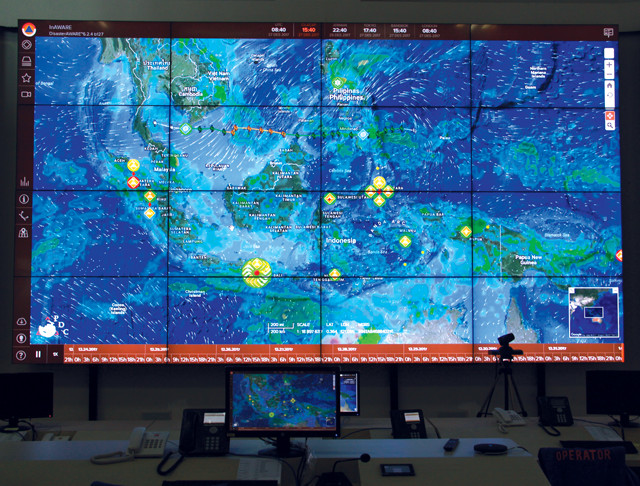
The interactive display of the InAWARE warning arrangement at the headquarters of the National Disaster Management Authority (BNPB) in Jakarta shows natural hazards — volcanoes, earthquakes, flooding, landslides and other types — affecting Indonesia. Credit: Wibi Pangestu Pratama.
Meanwhile, following the failure of the 22 previously deployed buoys, BMKG still lacks a functional network of ocean buoys and deep-body of water pressure sensors called DARTs (Deep-ocean Cess and Reporting of Tsunamis). These buoys and sensors tin can be linked with GPS systems to better measure seafloor displacement and notice tsunamis, but the InaTEWS system is not integrated at all with GPS networks configured for hazard warnings or for measurements of plate movement. It's a gap that could be hazardous. Of the 18 tsunami warnings that BMKG has issued since the system was set up in 2008, half-dozen have been false alarms, a success rate that could atomic number 82 to skepticism about the reliability of time to come tsunami warnings.
The Mentawai Gap: The Next Big Threat?
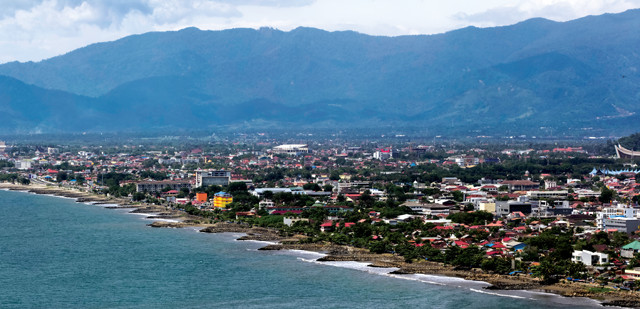
The metropolis of Padang, on the west declension of Sumatra, could exist severely impacted if a big earthquake occurs in the Mentawai Gap along the Sunda Megathrust. Credit: Crisco 1492, CC BY-SA 4.0.
The well-nigh functional GPS network in Indonesia is endemic by the Indonesian Constitute of Sciences (LIPI), a authorities research organization, and is jointly operated past LIPI's Enquiry Eye for Geotechnology and the Globe Observatory of Singapore (EOS). This enquiry array consists of nearly five dozen satellite-linked GPS stations on Sumatra and on outlying islands, says EOS technical manager Paramesh Banerjee. The array measures "movements of all the islands linked to the [Sunda Megathrust]" and other major faults, similar the Sumatran Mistake, Banerjee says. "GPS provides what is happening before an convulsion occurs — how the surface is deforming, and how the slip is occurring [on a fault] — and what happens subsequently a quake."
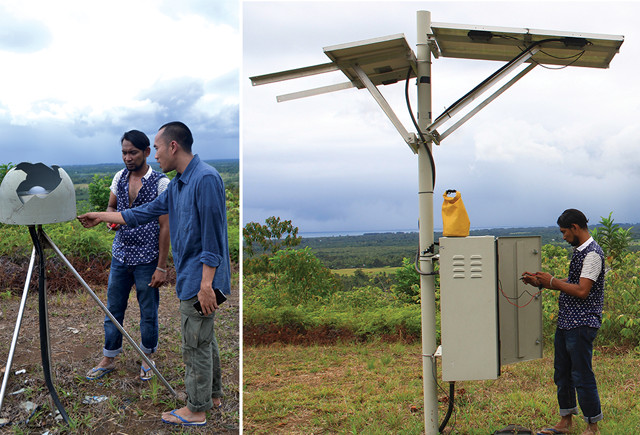
Left: Iwan Hermawan (foreground) of the Earth Observatory of Singapore and his technical assistant Hafiz audit a GPS station located near Padang, Sumatra. The outer casing of the station is broken, although the GPS unit itself is still operational. Correct: Hafiz tests the electronics for the GPS station to brand sure it'southward working properly. Credit: both: Wibi Pangestu Pratama.
The system could, in theory, be modified to work as part of a national earthquake and tsunami alert network, Banerjee suggests. "The best thing is to accept 1 integrated warning system in the Indian Ocean … one that is equally shut as possible to earthquake sources." As president of the Asian Seismological Commission, Banerjee is organizing a conference in China to attempt to create that network out of the patchwork of systems that exist today. Indonesia has announced it volition participate.
The Sunda Megathrust remains the most hazardous fault in the Indonesian archipelago. Many seismologists expect that the region's next corking earthquake and tsunami will likely happen in the Mentawai Gap, a portion of the megathrust near 90 kilometers west of central Sumatra. The gap hasn't seen a significant convulse in more than 200 years.
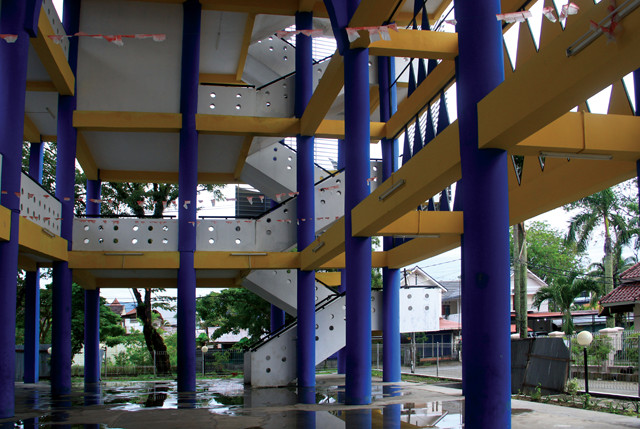
A third-story deck atop this fortified shelter in downtown Padang tin can arrange residents fleeing from tsunami floodwaters. The open design is intended to allow water to catamenia through. Credit: Wibi Pangestu Pratama.
"Mentawai is locked and loading with [seismic] free energy, and there has to be an result that will release that stored energy," says Iwan Hermawan, a geodesist and research fellow at EOS who monitors Sumatra. Forth the megathrust at Mentawai, the Eurasian Plate to the east has been shortening and bowing downwardly as the Indo-Australian Plate slides nether it. At some point, the accumulated stress will exist too great and a big earthquake — and, most probable, a tsunami — will occur.
The city most vulnerable to a potential convulse in the Mentawai Gap and a resultant tsunami is Padang, the largest metropolis on the western coast of Sumatra with a population of more than than 800,000. "The risk is high," Hermawan says, adding that he and EOS manager Kerry Sieh believe the Mentawai Gap rupture could happen inside the next few decades, or possibly sooner.
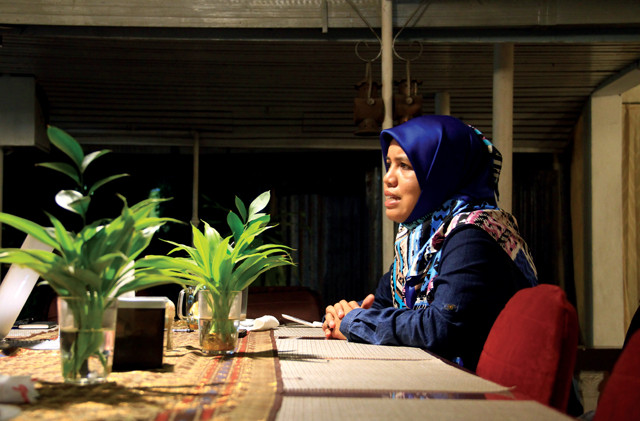
Patra Rina Dewi discusses tsunami education efforts in Padang. Credit: Wibi Pangestu Pratama.
"Much of the loss stemming from the bang-up Aceh-Andaman earthquake and seismic sea wave of 2004 could have been avoided," Sieh wrote in a 2007 Journal of Earthquake and Seismic sea wave newspaper. "Similar time to come losses from earthquakes and tsunamis in South and Southeast Asia could, in theory, be substantially reduced." Sieh wrote that Indonesia can improve its survival rates in a future disaster by focusing now on scientific discovery, public education near hazards, emergency preparedness, and the design and construction of resilient coastal communities.
But whether Indonesia is fairly prepared today — technologically and in terms of public awareness and preparedness — remains an open question. Some local customs organizers take been vigilant about educating the populace and persuading local government officials to act on evacuation plans, but infrastructure and budgets to back up such efforts are spotty.
Local Wisdom
Patra Rina Dewi, a scientist and tsunami educator with a nongovernmental organization called Kogami, has been conducting chance preparedness training for children and adults in Padang, and urging local and district governments to adopt evacuation and shelter plans. "Afterward 2004, we struggled to get a program of grooming going for the first two years, and at ane indicate in 2005, the Padang government asked us to end considering they idea we were frightening the tourists," she says. "But in September 2007, we had a magnitude-7-plus earthquake, and the government woke upward and started trusting our organization."
By 2008, Padang had a tsunami evacuation programme and the city had built tsunami shelters resembling multilevel parking lots that can hold almost five,000 people. Merely Dewi even so worries that hundreds of thousands of people won't escape depression-lying areas in time if a seismic sea wave comes quickly and washes out primal bridges and other infrastructure.
"Nosotros've done the training," Dewi says. "We at present tell our people that if the convulsion happens [and is] bigger than magnitude 7 … the authorities will make an announcement nearly a tsunami potential. If you lot feel a strong convulsion lasting 30 seconds or more and you can't stand up properly, yous must evacuate — simply don't accept your vehicles; merely walk. Get quickly to higher ground — walk at least 3 kilometers away from the beach."
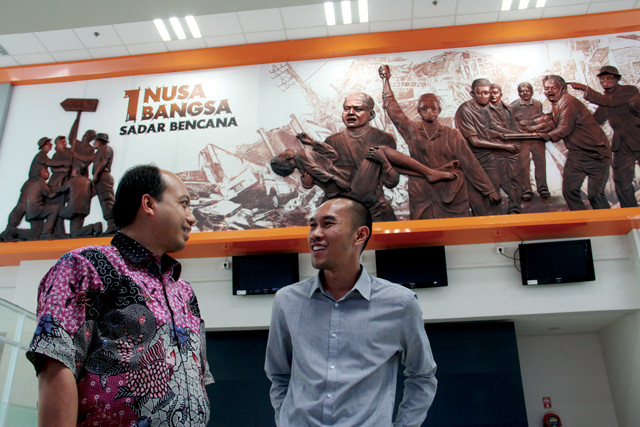
Sutopo Nugroho (left), information managing director of BNPB, talks with Iwan Hermawan inside the BNPB museum, which is defended to natural disaster rescue efforts and the preservation of cardinal artifacts. The sign above reads "Homeland Nation: Aware of Disaster." Credit: Wibi Pangestu Pratama.
Dewi tells people in Padang that the best way to avoid disaster is to recognize the signs for themselves — and as quickly every bit possible — considering improved monitoring technology and communication won't necessarily help if a massive earthquake happens forth a megathrust and forms a tsunami shut to the Indonesian islands. She shares her experiences as a rescue worker on Simeulue Island, about 150 kilometers west of Sumatra, after the 2004 convulsion and tsunami struck. Dissimilar Aceh Province on Sumatra, where nearly 170,000 perished, only seven people on Simeulue — out of 70,000 residents — drowned during the catastrophe, Dewi says, because locals recalled the stories of their ancestors who faced a tsunami in 1907. When the islanders saw the bounding main receding, but before the behemothic tsunami waves came crashing in, they knew to run for higher footing.
"The children I saw after weren't traumatized; they knew what to do and they seemed happy, even though they saw their houses disappear," Dewi recalls. "After I returned to Padang, volunteers showed me a mag maxim Padang is the riskiest city in the world for seismic sea wave," she says. That's when she discovered her calling. "I know something large will happen in the future if I don't contribute myself to save people."
And that'due south why rescue workers and organizers like Dewi and Nugroho believe that "local wisdom" is even more effective than GPS, seismometers or other technologies in warning Indonesians of coming disaster. "'Local wisdom' means people-to-people communication because, basically, disaster mitigation is from people to people," Nugroho says. "We are trying to develop and integrate local wisdom with engineering, so that communities tin build the capacity to cope with the disaster themselves," he says. "We call this the 'working together spirit.' This means the disaster belongs to u.s.a.. Information technology's our responsibility to deal with it."
© 2008-2021. All rights reserved. Whatsoever copying, redistribution or retransmission of any of the contents of this service without the expressed written permission of the American Geosciences Institute is expressly prohibited. Click here for all copyright requests.
Source: https://www.earthmagazine.org/article/hazards-paradise-indonesia-prepares-natural-disasters/

Publicar un comentario for "How Is Indonesia Trying to Prevent Destrution From the Tsunami to Ever Happen Again"