Allen Jones Sculpture Art the Most Sexist Art Ever
I find it very difficult to take an authentic response to work that has generated a lot of controversy in the past. My inner contrarian harasses me to disagree with the orthodoxy. Then I was all set to resist the feminist critique of Allen Jones, simply considering information technology would be predictable to concur with it. And yet, at the same time, I detest the way decades simply trump debate, so that the rut around Jones – that he didn't attack or brand problematic the objectification of women then much every bit art-ify it, arrive respectable – has only abated, equally he has become respectable, part of the canon.
Making every reasonable endeavor to shut off this cacophany, my first thought at the Royal University'southward new bear witness is: Jones's identity equally a painter has been the biggest casualty of his adventitious place in politics. Paintings such as Sin-Derella, a human being and a woman dancing with waists fused, their top halves invisible, juxtapose the make clean, clean lines of the pop creative person confronting the racked, evanescent certainties of the artist. Hot Wire, likewise, is a magnetic study of the intensity of art, showing the lesser half of a tightrope walker above what appears to be a ophidian. Early, joyful transport paintings, Sunday Airplane and 2d Autobus, capture not only his formal playfulness just the optimism of the start of the 1960s. The earliest experimentation with bringing paintings off the wall – Curious Woman from 1965, whose 3D breasts the painter picked up in a joke shop – has that same honesty.
The controversial sculptures – Hat Stand, Table and Chair – aren't shown together. This is because they were "not conceived as a group", says curator Edith Devaney. "They but share a visual language and were made at the same fourth dimension." The time was 1969. Withal I wonder whether that determination wasn't also fabricated to complicate their message with the work that surrounds them. Considering, equally single pieces, Chair peculiarly, they are still brutally arresting.
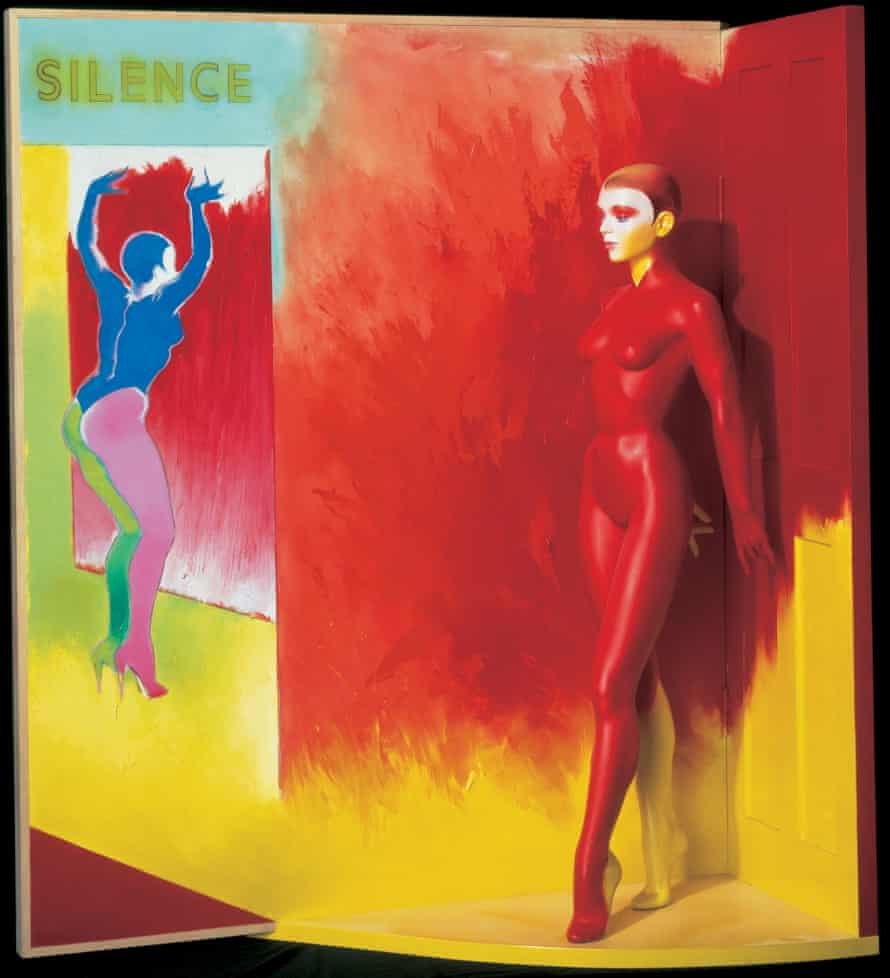
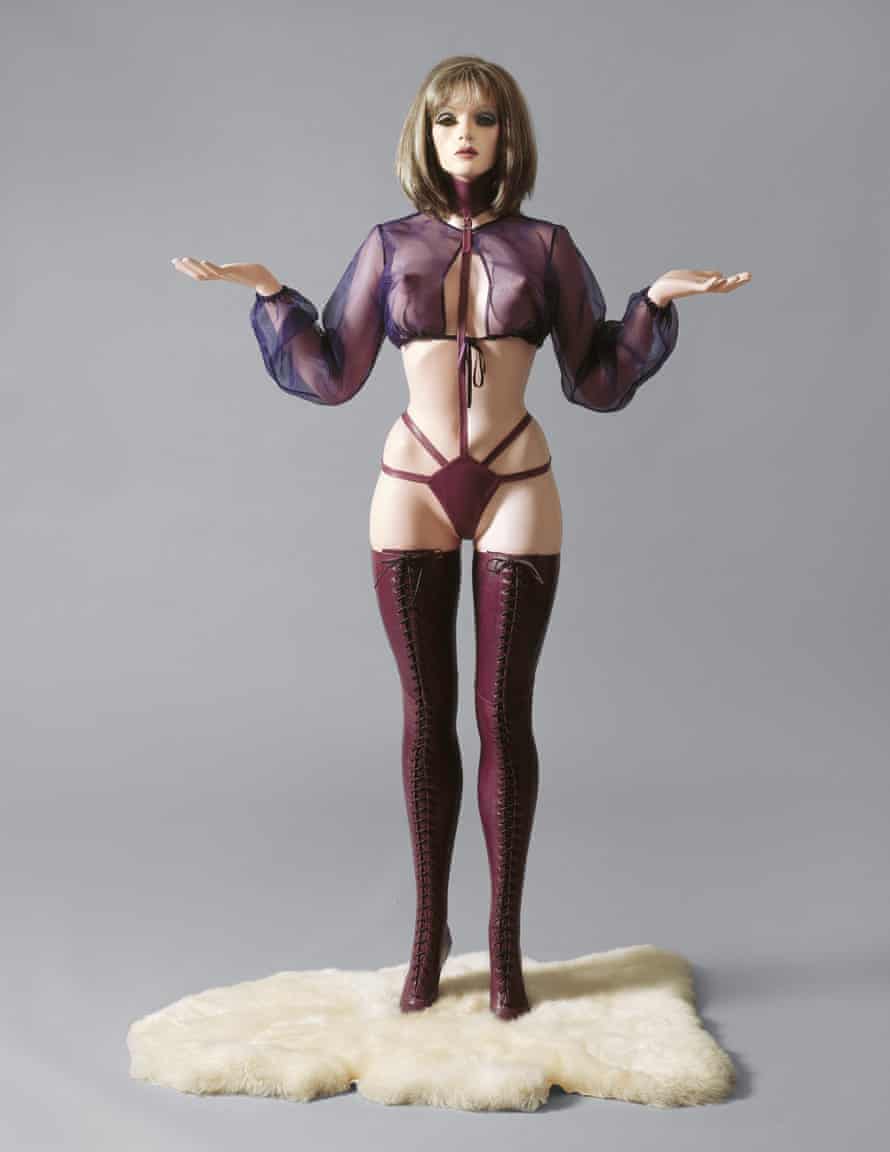
Hat Stand up is a mannequin in radial leather knickers and thigh-loftier boots. Chair is the most famous of the three: a woman lies on her back, with her knees confronting her chest and a absorber on meridian of her. That's the seat, her calves brand the chair's back. While all the clothes – black leather gloves, boots and a strap – reference bondage, she besides looks dead, trussed up gear up for some inept suburban disposal. Table, being topless, is more than classically provocative. It would be pushing information technology to say the figure was adopting a more than active shape, though: she'southward on all fours, belongings up a pane of glass with her back, her caput looking downwards into a hand mirror. Yet the physics of the position brand her look more like a doll than a corpse, and the outcome is more intellectual challenge than x Rillington Identify.
"Fetish wear doesn't appointment," Devaney says. Jones's Secretarial assistant – iii sets of crossed legs, disembodied pastel dominatrixes – could accept been fabricated yesterday. Or they could be a item from a Victorian erotica evidence. Hat Stand up could be an Agent Provocateur window display.
Fetish wear is timeless for the aforementioned reason illegal drugs are ever the same price. The black market doesn't seem to empathize inflation. Merely we're also looking at a dense coaction of deliberate and accidental reference: Jones's images have been so influential that about no image of woman-as-object or woman-as-other-object can exist created, even 40 years afterwards, that doesn't nod to them.

Jones's starting time clashes were with the art establishment: his paintings got him kicked out of the Purple College at the offset of the 1960s. In his own descriptions of his famous ungrouped group of sculptures, he all the same sounds every bit if he's shadow-boxing with that past and the keepers of artistic respectability, certainly not trying to feud with feminists. He was, he wrote, "presenting the figures as objects that would demand an immediate, not-fine art response: ie, chair – sitting; table – using. I attempted to dislocate the normal expectations when the viewer wishes to face up a work of art."
The challenge was, equally Natalie Ferris writes in Allen Jones and the Masquerade of the Feminine, that these sculptures came out at the same time as second-wave feminism non by coincidence, merely because they were both exploring the aforementioned thing: "the imagery of capitalism, in which the alluring female body did not act as a sign for its owner's own sexuality, but only as it existed for the male sexual imagination". But what did Jones's exploration amount to? Was it critique or endorsement? It seems pretty apparently that the sculptures aren't meant to be titillating, but are they debasing? If we accept that this battle existed, between the imagery of women-equally-sex-instruments on the one side, and women every bit whole people on the other, then only to represent it is feeble, a kind of proto-postmodern cowardice: "I'm not maxim this is right or wrong, OK? I'm just saying, 'Hither are some tits.' Get over yourself." From the time they were created until 1986, when Chair was vandalised with acrid, the sculptures were the subject of corking anger.
Taken against his other piece of work, it is impossible to excogitate of Jones as having one single view of women, in which they are objectified. An impressive gathering of his painted metal sculptures fills one room: couples folding in on each other, limbs merging, a sense that momentum collapses the distinction between i person and another, between genders. Information technology's eerie and entrancing, like a dancing army. Hermaphroditism is a strong theme, the lines of a woman's leg in 1966's Drama sliding into that of a man, like cells merging. Gender is a necessary exaggeration, a cartoon, to proceed apart these shapes whose existent drive is to be inseparable.
Nonetheless the exhibition and the debate information technology would one time have generated likewise underline how much the world has changed. Culture has go essentially supine in the face of that "imagery of capitalism" whose thrust has remained unchanged, indeed, has go even coarser and more than assertive: one gender equally meat for the other.
Before this twelvemonth, a fresh chair controversy was spawned when Dasha Zhukova, the gallerist and girlfriend of Roman Abramovich, was photographed on a pastiche of Jones'southward sculpture in which the woman was black as well equally looking dead (information technology's by the Norwegian artist Bjarne Melgaard). It's a cheap shot, borrowing someone else's complicated provocativeness and spicing it up with racism. Zhukova'due south defense was: "This photograph, which has been published completely out of context, is of an artwork intended specifically as a commentary on gender and racial politics." (That "out of context" remark is interesting: what would have been the correct context?) And if we're going to accept a conversation nigh race and gender, do we want it to kickoff with a rich white man and stop with Mrs Oligarch sitting on a black adult female? Jones was moved to respond: "I never intended the chair to be sat on."
Jones was the canary down the mine in 1969, observing obliquely: This is the existent direction of the pop art pivot-upwards, the woman separated by an ad man into all her pneumatic parts; this is where we're headed, to a place where women tin can be anything except people. Did second-moving ridge feminists shoot the messenger? Or did he mangle the message? The contend is yet open up.
Source: https://www.theguardian.com/artanddesign/2014/nov/10/allen-jones-sexist-art-royal-academy-review

Publicar un comentario for "Allen Jones Sculpture Art the Most Sexist Art Ever"